Now we know bipolar is not a genetic disorder…

The idea that mental illness was caused by bad genes was put forward by the Nazi party in 1936. Their propaganda, prior to World War II, altered opinions around the world and being such a simple concept it has stuck.

Science has not helped the situation by describing bipolar disorder as heritable, because it is influenced by the environment. It is now known that the Nazi idea was based on bad science. The heritable observations were entirely due to the environment, such as what was going on in the home that all family members were experiencing

All genetic studies to date:

1)      show no link to genetics

2)      environmental factors are the major cause of psychiatric problems

3)      fail to be repeatable

It turns out anyone can be diagnosed/labelled with bipolar disorder regardless of their genes. Genetics is not at all relevant to bipolar disorder. This has been proven by looking at all the published studies across the world.

On Friday 11th November 2011 Professor Richard Bentall presented a summary of evidence to date for the causes of psychotic illnesses. Major studies around the world have again and again shown that genetics are not significant.

Here is an example of how the myth been perpetuated: Four siblings were all diagnosed with schizophrenia and this was presented as evidence for a genetic link even after it was discovered that they had been repeatedly sexually abused by their father, with sexual abuse being known to be a major factor in developing psychosis regardless of a person’s genetic make-up.

Examination of 27,572 research papers has shown the following are all significant factors, sexual abuse, physical abuse, bullying, being of a very different skin color compared with the bulk of the population, being a homosexual, bisexual or trans-gender person in a place where people are not tolerant of such differences, diet, being from a poor family in a rich community, stigma of almost any kind, use of illegal drugs, use of legal drugs, living in a city. There will be other causes. This research did not show genetics to be a significant factor.

It has recently been found that the false teaching of genetics as a possible cause of mental disorder increases stigma and makes life more difficult for sufferers. This can be explained in the idea that, it is easier to live next door to a neighbor who seems to be struggling mentally due to stress, as most of us have experience of this, but it is difficult to relate to a neighbor who you believe has a faulty brain from birth. It will seem that they will always be different from you and you will not be able to help them.

There is no doubt at all that absolutely anyone can be diagnosed as having bipolar disorder regardless of race/genetics. Just look at the bipolar people we know – there is a complete spectrum.
Since 1955 #bipolarboom

Has there been an increase in people disabled by depression?

It is difficult to say for sure as there are so many ways of measuring disabled. Certainly mental health disability payments as a percentage of national income are increasing around the world. Organisations that support people with mental health difficulties are struggling with the numbers of people seeking help.

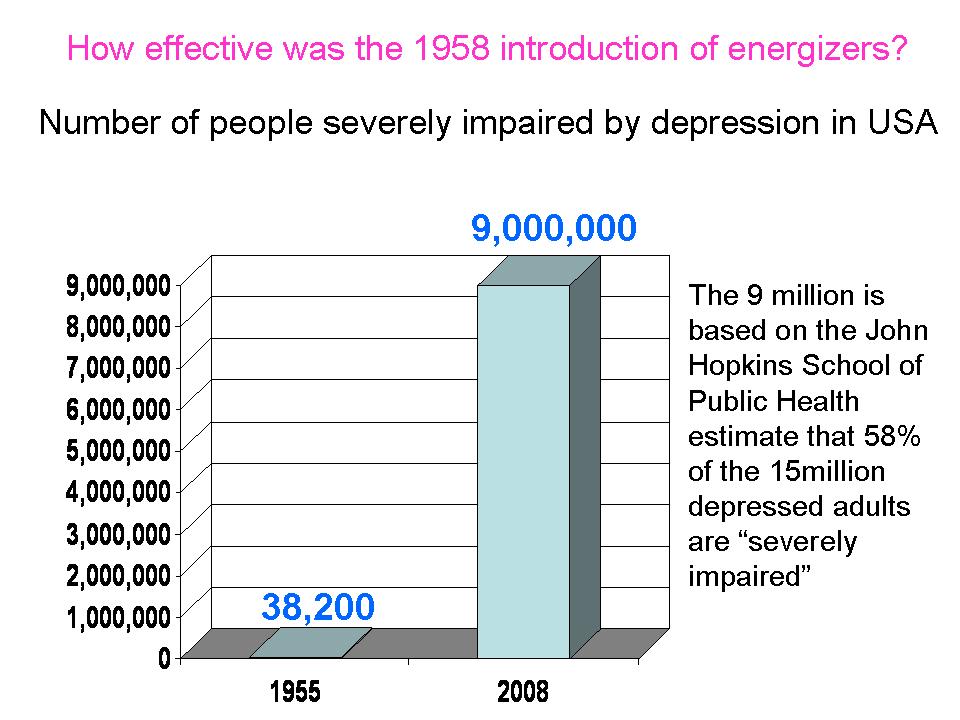
One way to look at the increase is by comparing figures for two years a long way apart as in this graph…

bipolar boom

Disabled by depression

I showed this as part of a presentation to 35 college staff.  I was surprised by the ferocity of response. I was told that the figures ‘do not compare like with like’. It is true. Ways of recording impairment have changed, yet don’t government agencies usually change the way they describe and measure things so that it looks like they are doing well? Here clearly things are not going well.

The second response was, “That is in USA and they have had a lot of wars in recent years.” I was a bit stunned by this then I remembered reading that there is a widespread belief that Americans for some unknown reason cannot cope with seeing and hearing about violent acts compared with the rest of the world. I feel the argument falls down when we consider America was heavily involved with the Korean war (25 June 1950 – armistice signed 27 July 1953), yet depression rates were low immediately after this war USA could not even claim to have won.

The third response was, “Why 1955?”. The top title on the graph explains this. It was just before the first drugs called ‘energizers’ became available to doctors. These powerful mood altering drugs had adverse effects. The boom in depression got under way. This was followed by the boom in bipolar disorder which is continuing worldwide today.

This recent article also uses 1955 as a reference point for the same reason. It is well worth reading. There are links to the scientific papers that prove depression is enhanced by drugs and bipolar is often caused mainly by taking drugs. http://bipolarblast.wordpress.com/2011/02/10/bipolarstudies/

In researching for our book, (Bipolar Disorder: A guide for mental health professionals, carers and those who live with it’), I was surprised to find that doctors are still able to prescribe some of the very first 1958 style energizers , even though they were proved to be ineffective. Would you recognised these drugs if you were offered them?

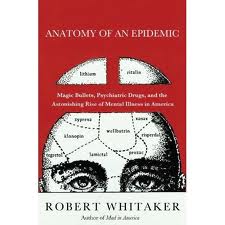
Highly recommending ‘Anatomy of an Epidemic’ by R. Whitaker 2010

Review of ‘Anatomy of an Epidemic’ – R. Whitaker 2010

anatomy-of-an-epidemic-bookAnatomy of an Epidemic is excellent. It is the best book of this type I have read. It confirms what many of us have believed about psychiatric drugs for a long time. I have recommended this book to my students. Even for people who firmly believe the information supplied by drug companies, this is a must read book to understand the views of millions who have taken the drugs, experienced worsening symptoms and bad effects.

Prior to this book I found it difficult to explain why drugs never been shown to be beneficial continue to be prescribed. This book has made my life easier. I only need to say that the facts are explained in Anatomy of an Epidemic.

Robert Whitaker’s style is excellent. It is a subject that can seem daunting yet he takes you on a journey from the first ‘energisers’ of the 1950’s to the more recent chemicals, which turn out to be surprisingly similar in action to the earliest ones.

One effect of the book is that I find I am now increasingly being asked questions about coming off psychiatric medication. It makes sense to ask. Stopping quickly is almost always a bad idea. Finding a doctor you can work with is an excellent idea and then working with that doctor to find ways towards lower/safer doses is likely to lead to a far better life.

Lithium in moderation

Many people have been told, “You will need to take lithium tablets for the rest of your life.”

It is a strange thing for psychiatrists to be saying when first prescribing this mineral. We know that for something like half the people who take lithium as prescribed it just does not do what it is supposed to do.

Could it be that lithium simply works in a similar way to all the other essential minerals like iron, calcium, magnesium, copper, zinc, selenium, with supplements only improving our health if we happened to be suffering a deficiency?

From a nutritionist’s point of view this makes perfect sense. If you have enough of a mineral and you are given more than you will feel worse. Most likely you will become more anxious or depressed. If you really are not getting enough dietary lithium then a lithium supplement will most likely help you to feel less depressed and anxious.

Here is an article I wrote about lithium being a mineral that most people can get from a balanced diet: Lithium for everyone

As always I need to stress that if you have taken lithium tablets then it can be extremely dangerous to suddenly stop taking the tablets. The correct way to come off lithium medication is to first talk to your doctor about ‘titrating down’ very slowly with appropriate monitoring. Would anyone like me to post details of how I reduced my lithium intake when I became concerned about side-effects?

Coming off psychiatric medication

Coming off medication can be risky. At time of diagnosis and prescription there needs be a plan for how withdrawal can be achieved. Without such a plan patients may believe they have to take the medication for the rest of their lives even when doctors are not thinking this way. Patients need to know what is realistically possible by way of recovery and coming off medication.

Withdrawal tends to work with tiny steps. It helps to find a doctor who knows about the medication, the likely withdrawal side-effects, believes you can do it and has time to work with you. It can take a lot of looking to find such a doctor in your neighbourhood.


When we do not feel like smiling

Sometimes we do not feel like smiling.

forcing a smile

Forcing a smile

Have you ever been too anxious or too depressed to be able to smile.

Forcing ourselves to smile several times a day reduces anxiety and depression.

Leaving a pen between your teeth is said to be more effective than antidepressants. It is a lot cheaper and no horrible side-effects!

Smiling can be the quickest way to feel better.

I used to believe that people become miserable then stop smiling. Now I mostly believe: People who stop smiling become miserable.  We all need to smile from time to time to feel good.

One American trend we can do without

bipolar children

Juvenile Bipolar Disorder 1995 - real data?

Juvenile Bipolar Disorder is a Myth

Over the years many trends have started in USA and made their way around the world. Very often the UK follows quickly, copying what happens in USA. Just think of rock ‘n’ roll, wearing blue jeans, increasing litigation…

Since 1994 there has been a trend in the USA that most of the world has avoided following: increasing diagnosis of children as having bipolar disorder. More than one million USA kids have been diagnosed with bipolar disorder. Although the average age of diagnosis in the UK has dropped from 40 down to 19 years old, young children who have variable moods are still viewed as children who have variable moods.

We all start life as babies who cry and scream just because we get hungry (behaviour indicative of extreme mood variability). Adults are not expected to make so much fuss. Toddlers can rush around knocking ornaments over, falling down steps and then in the same day crash out and sleep before going off to play again. A great many teenagers sulk. Many teenagers are thrill seekers. In adults all these behaviours typical of young people can be seen as signs of mental illness. Diagnostic methods for adults are not appropriate for children.

It is not possible to match a child’s behaviour to the diagnostic criteria for any form of bipolar disorder, so how have these 1,000,000+ children been diagnosed? From what I have read it seems that USA criteria were changed in 1994 making it easier to diagnose and prescribe powerful mood altering drugs to USA children. Psychiatrists elsewhere in the world are resisting these changes.

Please keep resisting. Give the kids help with understanding moods and help them develop a lifestyle for mood stability.

When a diagnosis rate doubles…

When a diagnosis rate doubles, health professionals get concerned.

After a talk I gave on ‘recovery from mood disorders’ a psychiatrist asked my opinion on the bipolar diagnosis rate reaching a new alarming high for young women in their city .

I remembered this conversation when I read “…the number of disabled mentally ill in the United states tripled over the past two decades…”

No one knows for sure why rates for diagnosing bipolar are increasing in so many countries.

Could the answer to far higher diagnosis of young women than the young men (in that city in 2010) be linked to medication? The young men certainly had alcohol as their drug of choice while the young women were more likely to tell their doctor about their troubles and be given antidepressants. Both drugs can make bipolar diagnosis more likely just that the more powerful drugs may take people to this place quicker?

Controversial?

Have you read…

Whitaker, Robert, Anatomy of an Epidemic: Magic Bullets, Psychiatric Drugs, and the Astonishing Rise of Mental Illness in America. 2010, Crown (Random House). ISBN 978-0-307-45241-2.

Crises change lives

After winning an Olympic swimming medal, Steve Parry was asked how he came to be so good at swimming. He said that at age six he could not swim when he fell off a canal boat and had to cling to the boat for ages to avoid drowning. He agreed that if this had not happened his parents would not have taken him for swimming lessons and he would have been unlikely to have made the Olympics.

Millions of people have been through a crisis and the experience has put them on a new path. Having a mental health crisis is often taken as a sign that it is time to change something in our lives.

Steve’s parents could have just noticed that he had a tendency to fall off boats and decided not to take him on any more boats. Our doctor’s may notice that stressful events cause us to have mood swings. They may recommend we avoid certain situations or give us medication. Neither of these options seem like the swimming lessons opportunity to me. Medication might be more like a life jacket – well worth having at times but not ideal to wear every minute of every day for the rest of our lives.

After psychiatric admissions in 1997, 98 and 99 my ‘swimming lessons’ for me was a Wellness Recovery Action Planning course, since which time I have stayed out of hospital and consistently needed less medication.

Wellness Recovery Action Planning – Leicester 6th Sept and 8th November 2011

Diagnosis plus medication is not ideal

Here is a second quote from Robert Whitaker’s book.

“…before medication, 15 to 20 percent of bipolar patients became chronically ill. Half remained symptom-free in long-term studies after a first hospitalization for mania or depression. Seventy-five to 90 percent worked, and showed no signs of cognitive decline.”

I would have been one of the 75-90% who stayed well without medication having no significant mood swings for 17 years and no talk of bipolar disorder until I was persuaded to take an antidepressant.

This is not about everyone giving up medication – some people need to stay on their meds. I am wondering how many others would have stayed relatively well if they had not taken that first tablet?

Whitaker, Robert, Anatomy of an Epidemic: Magic Bullets, Psychiatric Drugs, and the Astonishing Rise of Mental Illness in America. 2010, Crown (Random House). ISBN 978-0-307-45241-2.

When bipolar follows on from antidepressant meds

“Today, one percent of all American children have it, and more than 65 percent of them developed bipolar after being treated with a stimulant or anti-depressant” Whitaker

Most people I know and work with who have a bipolar diagnosis say that they took an anti-depressant shortly before they were diagnosed.

Health professionals need to think carefully before giving antidepressants to people who show any signs of bipolar disorder.

Whitaker, Robert, Anatomy of an Epidemic: Magic Bullets, Psychiatric Drugs, and the Astonishing Rise of Mental Illness in America. 2010, Crown (Random House). ISBN 978-0-307-45241-2.

Taking a break

bipolar balance

knowing our limits

A long time ago when I was very anxious I was given a drug to calm me down. I calmed down too much and I was given a drug to pick me up. I picked up too much and was given a mood stabilizer. With this came a diagnosis of bipolar disorder. These days, some might say that this was ‘Bipolar 4’ – The type induced by taking inappropriate medication.

For my quest to make it easier for people to be ‘undiagnosed when they never had bipolar disorder’ or ‘when the risks of becoming unwell again have receded’ it is paramount that I stay well.  If there are doubts about my health there will be a lot of people not wanting to listen to the ideas I put forward about recovery after bipolar diagnosis.

I have been busy for a few weeks with submission of the manuscript for our book on bipolar diagnosis for nurses.  This is now with the publishers with the publication date set for 12th December 2011. Now, I feel I can pick up the blogging again.

Doubters might say, “That proves he has a mood disorder. He blogs every few days then has to stop for a month – clearly he can’t cope.”

More realistically we all juggle the projects we are involved with, stopping and starting. Recognising how much we can realistically achieve and what can be stopped and restarted is a sign of healthy thinking. If I am at fault, it is in my feeling that I need to apologize for not blogging… This is driven by anxiety not by bipolar disorder.

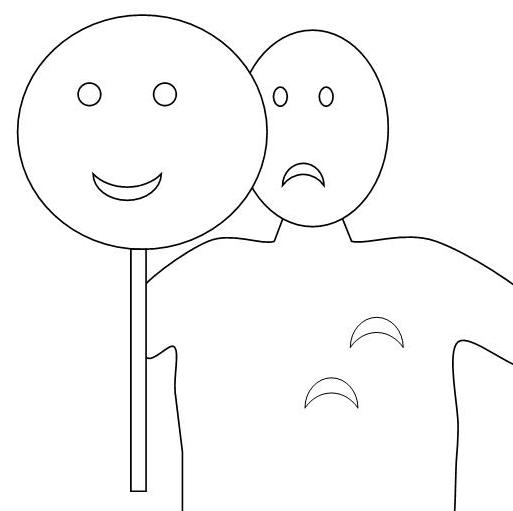
The mood we show and the mood we are

Consciously or unconsciously we sometimes show a different mood to the one we are experiencing.

Young children do not tend to do this. If a child is upset you usually know he/she is upset. We acquire the ability to show an alternative mood as we grow up. It can be a blessing, especially if you are a professional actor or have a job that requires not showing too much emotion. For example: If you are nervous when providing training, the ability to seem calm can help greatly as people like to learn from trainers who appear to be calm.

Judith’s comment, “I APPEARED to be calm, but later realized that I was NOT feeling calm at all”, highlights a problem for those at risk of a bipolar diagnosis.

Consistently looking calmer than we really are will delay help. When appearing calm our associates will believe we are coping. It is a common theme that people who are struggling with big moods fail to get early help because the extremes are not recognised early enough.

In recovery when we look and act calm, health professionals may believe:

1) we really are calm

2) our internal mood is not what we are displaying

3) we are pretending to be calm

How they help you will depend on this belief, so it is important they do what they can to be as sure as possible the calm displayed matches inner calmness.

This need to know more about the internal mood also applies for displayed levels of anxiety, depression and over-activity.

Would you agree that this is a skill that comes with experience?

Act as if #choosingyourmood

mood-act-as-if

sad inside – ‘putting on a face’

With the training I do, I have found that people who suffer from mood disorders and perhaps surprisingly those who care for them have low expectations of being able to choose a mood and then be in their chosen mood.

People who are making good recoveries from mood disorder and people who I see as doing very well in life have far stronger beliefs in their ability to choose their mood.

I have previous written about how people choose their moods by first choosing an attitude. Put simply this is a matter of ‘act as if’.

If you were to change your breathing to be rapid and shallow, like a person having a panic attack, you will almost certainly start to feel anxious. Please do not try this if you are prone to panic attacks. In fact there is no need to do this at all, as you already know it is true.

mood success

Good behaviours can create good moods

If you, now, change your breathing to be both slower and deeper, like a person doing yoga, you will almost certainly start to feel calmer. If you are not familiar with this technique for lessening anxiety, now is the time to meet with an expert who can teach you more about breathing, as it can be the simplest and least expensive way to take more control of your mood.

This is what ‘act as if’ is about. If you act like an anxious person, you will become slightly more anxious. If you act like a depressed person you will become slightly more depressed.

If you act like a calm person you will become a little calmer.

It works!

When it comes to mood we all already do some acting.

  • Can you think where sometimes acting can get us into trouble?

You can subscribe to this blog to receive high quality posts by email.