Stomach Acid 4 of 4 – A Longer Term Route to Better Health #notjustbipolar

On 7th July I blogged about all long-term disorders, whether it be bipolar, diabetes, schizophrenia, osteoporosis, chronic fatigue, M.E., arteriosclerosis (or any of hundreds of others) seeming to be caused largely by what we eat or fail to eat. More accurately, these disorders are linked to what our bodies ingest and digest, meaning that sometimes we may consume all the nutrients we need but if some are passing straight through us we will become unwell.

We need to have enough stomach acid, right when we need it in order that we get most benefit from our food and avoid feeling groggy/miserable due to poorly digested foods in our lower gut.

When unwell or very stressed it can be difficult to make enough stomach acid to digest all we eat and that is why I wrote about Nutrigest® as a ‘quick fix’. Now, I want to offer a long-term solution that requires something more like willpower rather than tablets. Although the best long-term plan must be: to continue to better understand about all aspects of understanding nutrition.

This solution to having low stomach acid comes in two parts:

  1. Go longer between meals and cut out just about all snacks.

This allows your stomach to have a rest and to be prepared to rapidly make lots of acid at exactly the time you need it. The stomach can then work on your food batch-by-batch, being guided by its acidity, keeping both valves tightly closed while doing its hardest work with its strongest acid.

This could be linked to ‘intermittent fasting’ but mainly I have found that just going a little longer between meals and minimising snacking can lead to big improvements.

  1. Avoid unnecessarily large meals.

This part I have found to be more difficult. I used to almost always have sensible sized meals, meaning meals that my stomach could easily cope with. However, when I reacted badly to Prozac I was told I would need to take Olanzapine for life to avoid being overactive.

Olanzapine is a drug also given to people with anorexic to help with weight gain. It is said to switch off the chemical message to the brain that is released as the stomach fills. On Olanzapine I was always hungry; overeating, but still hungry. I guess this stretched my stomach.

Coming off the Olanzapine gradually over several years allowed me to lose all the excess weight, but my appetite remained, with me craving food more or less whenever I was not asleep. I looked forward to every meal, talked about food excessively (I still do that) and would snack and snack at every opportunity.

One thing that can help with cutting down on the total size of a meal is to fill your plate with the amount you feel is right to keep you going to your next meal and before starting have a firm plan for what you will do as soon as you finish eating what is in front of you. Add to this the option to stop and put any remaining food in the fridge if you do notice you are feeling full enough.

All this may sound like just another weight-loss diet however the purpose is different from most diets and works for most thin people too when it comes to sorting out stomach acid. Having the right amount of stomach acid gives us the best possible chance of getting the most from our food and so the raw materials with which to combat disorders.

How common is low stomach acid among people diagnosed with bipolar and these other common disorders? It seems to be very common and many finding Nutrigest® to be very beneficial for mood. It seems likely we have all suffered from low stomach acid at some time as it is related to stress and we have all been stressed at some time.

I have described the above as a zero cost option, really though, it saves money. By going longer between meals and not snacking I have saved £75/month on my food bill.

In a future blog I will explain why it took me so long to make this change and how I have been able to go longer between meals and yet; feel less hungry, have more energy and feel much fitter.

Warning: If you are of very low weight or very unwell then be cautious about going longer between meals and discuss your desire to tackle low stomach acid with a nutritionist or your doctor before changing what and when you eat.

Warning: The label says not to take Nutrigest® if you have a stomach ulcer. Stomach ulcers are not as common as many people think, so if you were ever told you had one without appropriate testing then now could be a good time to ask to have your stomach checked by a specialist.

Please contact me if you would like to know more about this method of overcoming many common disorders. I can tell you more about the changes I have made for myself or share links to the research that shows less often and eating less helps most people.

Finally please be kind to friends and family who struggle with eating less. Very often drugs/medication drive us directly or indirectly to eat more, while modern living leads to stressed people who naturally want to eat to frequently hoping to relieve some of their stress.

Roger Smith – www.rethinkingbipolar.com – article updated 9th July 2014

Healing – Monica Cassani @BeyondMeds #beyondmeds

I just listened to Monica Cassini being interviewed on the radio. I am keen to share what she says.

Listen here to: Beyond Meds-Alternative to Psychiatry by The Wellness Journey

Monica Cassini

Beyond Meds Blog

Monica says a bit about how she needed to learn to live without psychiatric drugs. However, it is the other things Monica says about her recovery that I am hoping you will be able to listen to and think through.

Monica talks about  sorting out digestive problems (IBS), avoiding foods we are intolerant to, which for many is grains and especially wheat gluten, yoga and doing things like dancing when we have the energy to do so.

For me, Monica’s story is a familiar one. This is what I see in just about everyone who has been through the psychiatric system and is now well. It is recognizing our health (and moods) are dependent on good gut health and activity, such as walking, yoga or similar.

Neither Monica nor I are saying that is everything, it is just that digestion and movement are so often under-estimated by professionals and so often not seen as so important by ourselves when we are at our lowest.

Listen here to: Beyond Meds-Alternative to Psychiatry by The Wellness Journey


How Psychiatric Drugs Can Kill Your Child – Documentary Video #psychiatry

Psychiatric Drugs

Think carefully before agreeing to take any drug. Many drugs can be more powerful than we think they are going to be.

This is a longish documentary film. I found it interesting to simply listen to this while working on something else – the spoken words speak for themselves.

Warning: Lots of mention of suicide

Lithium – serious stuff #lithium #bipolar

Lithium – I felt readers might be interested in this email…

Hi Mary,

We both know that lithium is toxic – but then everything is kind of toxic if you have too much of it. (Example: We need sugar, but too much sugar gradually kills us.)

What do I know about lithium?

I graduated as a chemist in 1980 and have worked in chemistry (pharmaceuticals and food) most of my life. I have also spent a lot of time studying lithium and co-authored a 350 page on bipolar.

Lithium occurs naturally. We all consume tiny amounts of lithium from our food and water every day. Tiny amounts do very little damage. Depending on where you live and what you choose to eat you are probably consuming no more than 1mg/day of lithium if not taking tablets. There have been studies that have led researchers to suggest that 1mg/day has a mood stabilizing effect.

How much damage lithium does is very much linked to dose. Most doctors prescribe far too much. The blood test limits are (I believe) set far too high.

People who stop taking lithium quickly almost always get very ill.

People who stay on the prescribe dose end up with badly damaged kidneys – I know this because that is what I have now and I know of many others also now with kidney damaged (and many who have died through kidney failure). I am not going to go into huge detail.

I am going to make recommendations:

1) Get your kidneys tested and scanned now, so that your doctor will be able to monitor your kidney function. It naturally goes down with age, but while on lithium you need to keep an eye on your kidneys.

2) Do not even think about stopping your lithium. You are relatively well now and stopping any time in the near future will almost certainly lead to unwellness.

3) Make a plan for gradually reducing the amount of lithium you are taking. Consider how you would go about taking just 10% less. If on two tablets per day that could be a matter of cutting a quarter off one tablet and not taking that (a 12.5% reduction).

4) Discuss your plan with someone you trust. Ideally discuss with your GP. The thing people need to understand is that just by reducing the dose by about 10% will most likely prevent a lot more than 10% of the kidney damage you will be suffering. It is generally true of toxins that it is the excess that does the most harm. For example: We all consume arsenic in our food, but it seems to do us no harm at all, and yet it is a well-known poison if taken in one big dose.


I came off lithium, little by little, over several years. I felt healthiest and with the most stable moods I have ever had when I got down to about 50mg/day. This was down from the 650mg/day that I was on for many years. I am not unique in finding that low levels of lithium work better than high levels.


Warnings:

1) Reducing too quickly will destabilize mood – slower is better – your plan needs to be a reduction over a year or more, but the sooner you start the longer your kidneys will last.

2) When you do get to be on a lower dose, do not believe anyone who tells you that you are on a ‘sub-therapeutic dose’ or says that it is not worth taking 100mg or 50mg. These low doses most definitely do influence mood. I know 3 people who were each doing well on 100mg and their doctors told them to stop. They stopped and got very unwell.

3) Coming off lithium completely is likely to be difficult and dangerous – aim simply to take less – maybe a long way in the future you will find specialist help with getting off that last bit, but for now work out how you can take a bit less.


Roger

Changes needed in psychiatry – A short video from Dr Dr. Joanna Moncrieff #psychiatrist

Dr. Joanna Moncrieff – psychiatrist and senior lecturer at University College London shares some of her views on how psychiatrists could do better work by learning more about the drugs they are prescribing:


Ups and Downs – Video – Alice Hicks and Roger Smith #bipolar

Alice and I made this film at Rethink’s London  HQ on the Thames just before the 2012 Olympics.

Ups and Downs video on Utube


Ups and Downs – Research Report Published #bipolar #bipolardisorder

‘Listen, empower us and take action now!’: reflexive-collaborative exploration of support needs in bipolar disorder when ‘going up’ and ‘going down’. Billsborough J, Mailey P, Hicks A, Sayers R, Smith R, Clewett N, Griffiths CA, Larsen J.

This is an article published in J Ment Health. 2014 Feb;23(1):9-14. doi: 10.3109/09638237.2013.815331.  US National Library of Medicine National Institutes of Health

http://www.ncbi.nlm.nih.gov/pubmed/24484186

This was a project I was involved with and that I will say more about soon. 

I was fortunate enough to present this work at Nottingham University in 2012, where I concluded with one thing I learned from the study. Influenced by a sister of someone with a bipolar diagnosis who I interviewed during the study this thing I learned was that a (maybe ‘the‘) key factor in recovery and long-lasting wellness is love or if not love then it is something very like love that a lot of us need.

I have to admit that perhaps only one of all the people we interviewed actually said ‘love’, it is just that with everyone interviewed telling us how much difference it made when they were ‘really’ listened to… it is seemed clear to me that something very like love from the people closest to us makes all the difference.

As I say, I will write more about this research later.

Roger

What is bipolar? / Types of Bipolar #mentalhealth #bipolar

What is bipolar? / Types of Bipolar

Bipolar recovery requires finding out about causes, but first we may need some understanding of the psychiatric bipolar categorisation in use today.

Receiving medications for bipolar disorder is a serious thing, with patients on average dying 20 years earlier than the general population. However, with no medical tests for bipolar, it has only ever been a way of saying, “Something is wrong with your moods but we do not know what is causing it.”

With such a wide meaning then:

  • Are we all, from time to time, a bit bipolar?
  • Are there as many forms of bipolar as there are people in the world?

Bipolar is about categorization rather than diagnosis. Diagnosis means identifying causes, so technically speaking no one can ever be diagnosed as bipolar because bipolar categorization is reserved for people where the cause is not being identified. Bipolar categorization is about labeling.

There are four main categories of bipolar:

1)      Bipolar 1: This is the label given to people who admit to having low energy moods and have been seen to have some extremely high energy moods, whether associated with positive or negative feelings. This is equivalent to the old Manic Depression, other than; the highs in bipolar often being unpleasant with negative feelings or a confusing mix of positive and negative feelings, rather than the traditional manic depressive’s high which was considered to be a kind of ‘happy’ time for the person experiencing it. When the bipolar label first became available to psychiatry in 1980 this was the only type of bipolar.  Although the numbers with this label continue to grow it still accounts for less than 2%* of the adult population.

2)      Bipolar 2: This relatively new label is probably the fastest growing in the UK and may already have been applied to nearly 10%* of the adult population. It is used for people who admit to having low energy yet have never been seen to have extremely high energy moods. It tends to be given to people who previously would have been described as depressed as well as to people who suffer from fatigue syndromes where mood changes seem to be their main problem.

3)      The next less severe bipolar option is called cyclothymia, rather than bipolar 3. It again informs us, “Something is wrong with your moods but we do not know what is causing it.”

4)      Bipolar 4: This can be used when there is no dispute about a prescribed drug or ‘street’ drug triggering the damaging high energy moods. (It is unlikely to be used if the trigger is thought to be ‘a legal high’, nicotine or caffeine.)

At first a label can help us find support, however, bipolar labels stay on our (UK) health records for life, often preventing professionals from looking for or tackling the causes of our troubles.

In many ways the exact label is not so important. The part that needs to be tackled is the cause or causes. Only by getting to grips with what causes us to be seeing a psychiatrist can we start to make a lasting recovery, otherwise we will continue to have to manage/cope with moods we do not want to be having.

I am hoping I can help readers to find and tackle the causes of their disordered moods.

Roger A. Smith

31st January 2014

*In the UK it is difficult to know exactly how many people are affected as many people are not told what is in their medical notes. I would like to hear from anyone who can provide up to date estimates of numbers affected.

Adrenal Fatigue by Dr James Wilson – Book Review #adrenal #adrenalfatigue

Adrenal Fatigue by Dr Wilson – Book Review

People diagnosed as bipolar often end up suffering from chronic fatigue. I wanted to understand how this may relate to poorly functioning adrenal glands, so I researched on-line, talked with nutritionists, experimented with my diet and read two chunky books about Adrenal Fatigue. This book, simply called Adrenal Fatigue is for me the better of these books.

Adrenal Fatigue covers everything you might want to know, including recognizing adrenal gland problems, blood and saliva tests, adrenal fatigue book dr wilsonwhat adds up to causing the problems, why adrenal function is often not being recognized, how the adrenal glands function and what to do to feel well again.

I was amazed at the strength of opposition from drug companies, most mainstream doctors, endocrinologists and health services (such as the UK’s NHS) to the phrase Adrenal Fatigue. The official line from all these people is that adrenal glands cannot be fatigued, with only extreme adrenal dysfunction being recognised and considered treatable. The extremes are; Cushing’s-Syndrome, where the adrenals produce far too much cortisol and Addison’s-Disease, where the adrenals produce far too little. Both of these extremes are said by mainstream doctors, and perhaps crucially by insurance providers, to be unrelated to the fatigue that millions suffer. Most doctors are unable to react to test results that show the adrenals are not at peak performance as their training is that this does not need any medical response.

Dr Wilson (who was the first to use the phrase Adrenal Fatigue) along with a significant minority of doctors and nutritionists around the world, is saying we need to pay more attention to our adrenal glands. How well our adrenal glands are able to work depends on many factors whilst changes in lifestyle can get most people who are suffering from fatigue back to something like their normal selves.

Perhaps the oddest thing about this conflict between Dr Wilson’s supporters and the established health services is that the latter recognise a condition called Adrenal Insufficiency, which they say has nothing to do with Adrenal Fatigue – even though it has EXACTLY THE SAME SYMPTOMS! Maybe this disagreement is just about the label and really it makes no differences whether years of stress and poor diet have caused our adrenal glands to be fatigued or insufficient. Either way, it feels real when you find yourself having to go to bed (or in extreme cases just lie down on the floor, unable to even walk to a bed) in the middle of the day.

What I have learned from the book, which is supported by strong evidence and many experts other than just Dr Wilson?

  1. The approved saliva test is well established and does indeed give a good indication about how your adrenal glands are working during the day of the test.
  2. Although improving diet and gradually doing more gentle exercise will almost always help, having fewer stressful events/fewer stressful days will make the biggest difference and allow for the most rapid recovery.
  3. The book’s recommendations for dealing with adrenal fatigue are so closely related to what is known to be good for general health and fitness that following Dr Wilson’s advice will improve almost anyone’s health, regardless of your beliefs about adrenal fatigue/insufficiency.  The book is full of good health advice.
  4. The scientific part of the book is good science and matches well with the chemistry I learned when completing my BSc many years ago. Facts such as the adrenal glands convert cholesterol to cortisol in order to help you cope with every day stressors and have any energy at all are indisputable.

Did Dr Wilson’s book help me?

Yes, definitely! While reading the book I made some small dietary and lifestyle changes. These have allowed me to have more energy and to have that energy for more hours per day. This is not the same as cured but it could well be that I am on a good road of recovery from the extreme fatigue (Chronic Fatigue Syndrome) I was suffering from.

How did the book help?

There are lots of ideas in the book that all helped a little. It was useful to be reminded that I need good healthy fats to make enough cholesterol to allow all the other hormones to be made as needed. Without eating healthy fats everyday our adrenals are going to struggle

The idea that made the most difference for me was almost the simplest in the book and is in some ways so obvious that my GP, and all the other specialists I have met with, missed it. Dr Wilson does not make a fuss about stress and poorly functioning adrenals causing sodium depletion. He just states it, as a well-known fact. However, this led me to look closely the records I had made for my nutritionist about the exact amounts of every food and drink I consumed on many days during 2013. It turned out that without eating processed foods (such as bread, cakes and takeaways) I was not having anywhere near enough sodium in my diet. Meanwhile by eating fruit, nuts and generally a lot of things I felt would be good for me I had increased my potassium intake.

The net effect of low sodium and high potassium was that I was suffering variable and often very low blood pressure. By monitoring my blood pressure and gradually increasing my sodium intake up to the UK’s recommended daily amount, I feel I have twice as much energy and half as much fatigue, just through that one change. An example of this: after moving house my washing machine just sat in the kitchen unconnected as I did not feel able to even attempt to move it to plumb it in. After just two days with a little extra sodium (half a teaspoon of sea salt) I moved the machine and plumbed it in as if I had never a fatigue disorder.

Were there ideas from Dr Wilson that may not have been so good?

I could not see anything wrong or illogical in Dr Wilson’s work. However, I am not convinced about Dr Wilson’s supplements. A friend bought me a bottle and I took one a day. I cannot say that I took these long enough or enough per day to say whether the tablets were useful or not. After a few weeks I did not like the smell of the tablets and stopped taking these. Being meat based I wonder if this supplement might be of greatest benefit to those who do not normally eat much meat?

Overall, I am going to say, that if you have any interest at all in how people can be less fatigued this is essential reading and I highly recommend ‘Adrenal Fatigue – The 21st Century Stress Syndrome’ by Dr James L. Wilson.

Roger A. Smith, Rethinking Health Ltd

Bipolar weight gain, bipolar weight loss

I just read this article: Accepting Weight Gain in Bipolar Disorder

All the drugs used for bipolar are sedatives. In general: Sedatives are far more likely to cause weight gain than most other drugs. Some sedative drugs such as Olanzapine/Zyprexa are exceptionally good for putting on weight and can be used to help people who are anorexic.

I found that small decreases in dose allowed me to lose weight, with the weight coming off about 2 months after reducing the dose. However….

When I had to give up all the psychiatric drugs to protect my physical health, about 2 months later my weight started to go down rapidly. I was eating as much as I possibly could but I just got thinner and thinner.

Being bipolar and thin is at least as much of a problem as being bipolar and fat. Family tends to associate thinness with mania. I was happiest (most often in the moods I wanted and needed to be in) when I was on a very low dose of sedative.

If you feel you are too heavy then find ways of needing a little less of the sedative drugs (sedative ‘antidepressants’, sedative ‘anti-psychotics, sedative ‘mood stabilizers’) – it is well worth doing this even if you have no plans at all for ever getting off the drugs. Less is better… none at all is a difficult path.

Bipolar or Adrenal Fatigue Part 1 of 3

Bipolar or Adrenal Fatigue

There are many causes of variable energy levels. If you used to be OK and now you are not so OK, you may be wondering what is going wrong.

How you describe your struggles can make a huge difference in how you recover and get back to something like your usual self.

I am only just starting to study Adrenal Fatigue, so bear with me as I make tentative efforts to show the similarities and differences between this and bipolar disorder diagnosis. I intend to come back to this article and make it more detailed and precise as I learn more about Adrenal Fatigue. In fact I am going to publish this only part written and add to it bit by bit when I have the energy to do so.

Similarities and differences:

ENERGY:

  • Both diagnoses involve changes in energy level
  • Adrenal Fatigue is likely to affect you to some extent every day until you deal with whatever is causing it. Bipolar disorder is said to come and go and is said to allow you to have days that are symptom free. If you are running out of energy during daylight hours when you did not used to run out of energy then this is likely to be related to poor functioning of the adrenal glands.
  • If you are suffering from Adrenal Fatigue you are likely to have or seem to have periods of higher energy as you are likely to need to be very busy while you do have energy to catch up for when you do not have energy. If you have Adrenal Fatigue and are not dealing with it then you will find these periods of higher energy get shorter and perhaps less frequent. The bipolar diagnosis does not necessarily predict shorter and less frequent high energy periods.

MEDICAL TESTS:

  • There are no medical tests for bipolar diagnosis. Bipolar disorder is a psychiatric label that covers a range of physical and psychological troubles. It cannot be detected by brain scans or blood tests. Bipolar is diagnosed by observing someone who appears to have variable moods and involves asking questions of that person, their family and people who come in contact with them. To a psychiatrist or similarly informed doctor anyone with Adrenal Fatigue could be thought to have bipolar disorder.
  • Adrenal Fatigue blood tests – The adrenal glands produce cortisol and a hormone (maybe technically better described as a hormone precursor) known as DHEA. The adrenals produce the ideal level of these chemicals to match your body’s requirements. Both these naturally occurring chemicals can be detected in the blood. The level detected in a blood sample gives a snap-shot of how your adrenals are working. Exceptionally low levels are associated with Adrenal Fatigue. However, you and your doctor need to know the time of day the sample is taken as cortisol and DHEA vary throughout the day.
  • Adrenal Fatigue saliva testing – Cortisol and DHEA are small molecules that travel to all parts of your body including the saliva glands. The test involves spitting in a sample tube and this being sent to a laboratory for analysis. With no need for syringes and needles this test is relatively inexpensive. The main advantage of this test over blood tests is that it is easy to take several samples in one day and with less stress than making a trip to your GP for blood to be taken. How the cortisol and DHEA vary during the day allow a precise measure of how your adrenals are working and it only takes one day of testing to confirm your level of adrenal fatigue.
  • I will repeat here that there are no medical tests for bipolar disorder. If you suspect you may be diagnosed with bipolar disorder a good option is to ask for a day of saliva testing just to be sure your symptoms are not related to Adrenal Fatigue.

OTHER SYMPTOMS:
If your adrenal glands cannot produce enough cortisol quickly enough you will struggle with all situations that you find stressful. With insufficient cortisol you will be displaying all sorts of symptoms of Adrenal Fatigue that match symptoms of bipolar diagnosis.

  • Sleep pattern: Variable and seen as problematic for both bipolar and Adrenal Fatigue
  • Need to lie down during daytime – only said to happen during depressed phase of bipolar. With Adrenal Fatigue this is going to be happening most days unless you are consistently stimulated – perhaps having a demanding daytime job, so have to keep going and then collapse in the evening.
  • Irritability – You need a good level of cortisol to be able to cope with annoying people and without enough you will react in a way that ‘bipolar people’ are said to react.
  • Concentration – same as bipolar.
  • Pessimism, periods of feeling hopeless/helpless, negative thoughts and feelings – all the same as bipolar.
  • Reaction to stimulants such as caffeine – as for bipolar
  • Appearance – likely to be over-weight or under-weight with a tendency to lose weight when not taking sedatives, such as ‘antipsychotics’ / ‘antidepressants’ / ‘mood stabilizers’. Often looking tired – as for bipolar
  • Development of food intolerances – as with bipolar this may be several years after diagnosis.

TREATMENTS:

  • As with bipolar lifestyle changes, such as; what you eat, what you drink, what drugs you take and avoid, who you spend time with, the time you go to bed and so on, will decide the course of the disorder.
  • In general, bipolar disorder diagnosis (in the UK at this time) results in a lifetime of medication. Adrenal Fatigue rarely requires any drug treatment and recovery usually involves finding ways of living with minimum use of drugs.
  • Treatments for bipolar will in the long run make your Adrenal Fatigue worse.

I have typed all the above without reference to any text books or on-line articles. There may be errors. I am going to publish this as blog on www.rethinkingbipolar.com in this rough draft form, as I think it is such an important debate that needs to happen. Are millions of people whose adrenal glands struggle to cope with the modern world being diagnosed as bipolar, and not being given advice on how to look after their glands and feel less stressed?

Bipolar or Adrenal Fatigue – Part 2 – Diagnostics #adrenal #adrenalfatigue #bipolar

Bipolar or Adrenal Fatigue – Part 2 – Diagnostics

We can come to believe we have bipolar disorder by going down a check-list and finding we match just about all the symptoms.

Adrenal Fatigue has similar check-lists such as Dr Wilson’s Adrenal Fatigue questionnaire: http://www.adrenalfatigue.org/take-the-adrenal-fatigue-quiz

If you are living a busy stressful life and unable to relax you will most likely get a high score on both bipolar and adrenal fatigue check-lists.

My scores indicated severe Adrenal Fatigue, which makes sense considering what I been through and my lifestyle. However, are quizzes like these truly diagnostic? They do not tell us much about the causes. Our responses are based on our own feelings and not precise measurements.

With bipolar this is all we have. It is not possible to scientifically diagnose anyone with bipolar as there are no blood tests, brain scans or anything like that for bipolar. There cannot be as bipolar is simply a word used for anyone who has extreme struggles with their moods, regardless of why they are struggling.

Adrenal Fatigue differs from bipolar: Accurate laboratory based tests for adrenal function/dysfunction have been available for decades.

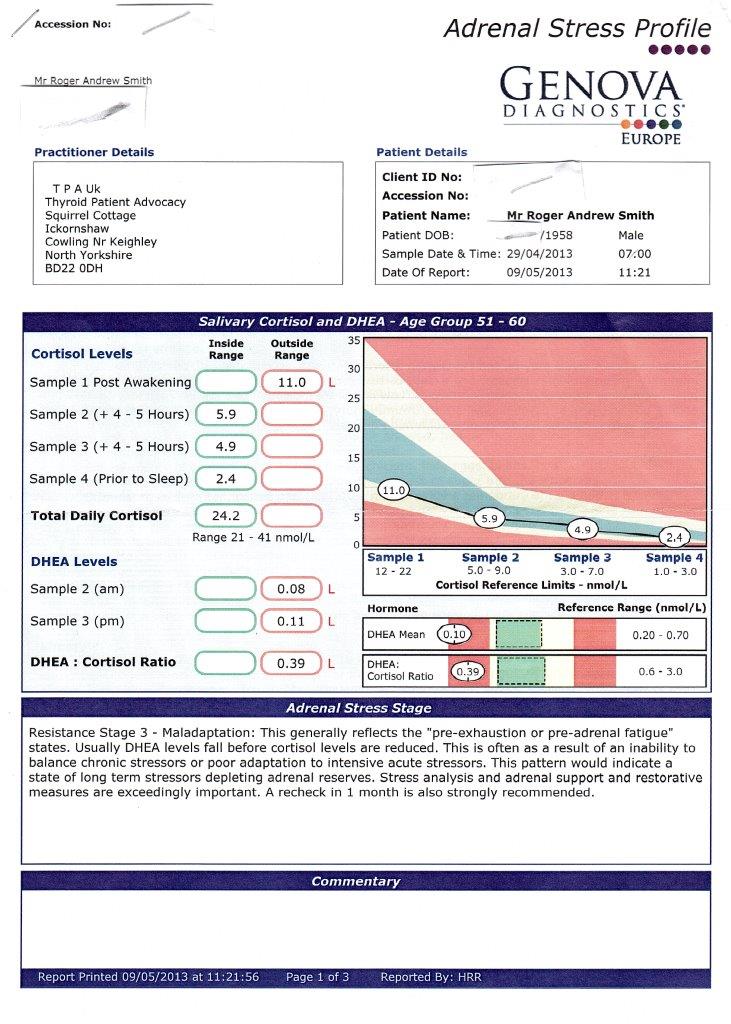
  •  Adrenal Fatigue Saliva Test: The adrenal glands produce hormones including cortisol and DHEA. These small molecules travel to all parts of your body including the saliva glands. The test involves spitting in a sample tube for laboratory for analysis. This is better than blood tests as it is less stressful and allows for several samples in one day. It is how the cortisol and DHEA vary during the day that allows the precise measure of your adrenal function. One day of testing will confirm your level of adrenal fatigue. Results are provided as a graph, showing changes throughout the day.

My adrenal function test results from April 2013 – click image to see it enlarged:

adrenalbipolar

Adrenal function test results

Cortisol is naturally high in the morning and decreases towards bedtime. If it does not start high enough or drops too rapidly you have most likely got a problem.

DHEA is so central to hormone production that a good level of this is needed at all times. Low results indicate lifestyle changes (perhaps better diet and more rest) are needed.

This test may be better described as a test for Adrenal Dysfunction as the test tells us about how our adrenal glands are performing rather than being directly related to how fatigued you are feeling. Adrenal dysfunction means your energy levels stop matching what you need and when you need it. Dysfunction eventually leads to fatigue.

What does all this mean?

  1. Nobody, not even you can prove you have a disorder called bipolar.
  2. Doctors can measure and say for certain how your adrenal glands are performing and if under-performance is affecting your mood.

If you have been diagnosed/labelled with bipolar, schizophrenia, depression, chronic fatigue syndrome, M.E. or similar then ask your doctor about having your adrenal glands tested through saliva testing. If your doctor says, “No” then consider paying for this test. I think it cost me about £80. If you want me to look up exactly what I paid and where I had the test done, then contact me through the comments option on this blog or through www.rethinkinghealth.co.uk

Bipolar or Adrenal Fatigue – Part 3 of 3

There are many conditions that lead to bipolar diagnosis. Adrenal dysfunction is just one possibility as discussed here in response to a member of the Institute of Optimum Nutrition.

Thank you for your useful contribution to my comparison of adrenal dysfunction with bipolar diagnosis.

Poor diet is one of the main causes of mood disorder, so the link to the Institute of Optimum Nutrition is going to help a lot of readers. The nutrients mentioned are all important and as you know there is a lot more about our diets that need to be taken into account. Moving on from a bipolar diagnosis will involve dietary improvements as part of a recovery plan.

In saying adrenal fatigue is mistakenly being diagnosed as a psychiatric disorder I was very much thinking all forms of bipolar other than the old manic depression diagnosis that involves people getting extremely busy, having grandiose plans and as you say, “have enough energy to rush around.” This state is described as mania and may also involve noticeable loss of touch with reality, with delusions and/or hallucinations.

In the more modern forms of bipolar, which are now by far the more common diagnosis, there is a much closer match with adrenal fatigue. With the Bipolar 2 diagnosis the patient has long periods of low energy and negative feelings, with short-lived periods of having a little more energy often not even noticed by friends and relatives. With another form of bipolar called cyclothymia the periods of low mood are not usually disabling but just keep on happening, and again without any extreme highs.

What I have noticed is that like me, people may initially see a doctor when having plenty of energy and asking for help, but after several years of involvement with psychiatry the high energy periods become shorter and less extreme until the pattern of moods looks more like on-going fatigue.

I am sure we are agreed that Adrenal Fatigue is best not described as a psychiatric disorder. I am hoping is that my articles will remind doctors that there are many reasons for apparent mood disorders. The other imbalances you mention (hormones, nutrients, food intolerances, blood sugar) do cause imbalanced moods and do need to be addressed first along with external stressors.

Most people who start off appearing to ‘be bipolar’ eventually end up fatigued and coping with exhaustion becomes our biggest daily challenge. (As discussed elsewhere sedative psychiatric drugs can cause more fatigue.)

Too often a bipolar diagnosis is given without looking for other possible causes. Adrenal Fatigue is just one of these possibilities and there are many more that I wish could be checked out before psychiatric labels are considered.


No mention of bipolar: Lisa Rodrigues: A very personal ‘personal best’ – None of us has to say the word BIPOLAR

I heard from a reader of rethinkingbipolar yesterday. They said how this blog had helped them greatly. This has inspired me to start blogging again. I never stopped completely. It is just that i have not published much while going through divorce, moving house several times in a year, closing down my office, being given several new diagnosis and generally beating myself up for being such a loser. I never wanted to be a divorcee – now I just need to accept that I am and get on with what I set out to do with rethinking bipolar – and that is to get more people to realize bipolar is nothing like what it says in the text books and most importantly people and perhaps all of us can one day move on from the diagnosis.

I am doing something unusual here by reproducing an entire article because it impressed me so much. (The link to the original has stopped working. 3rd March 2018)

Please do read all and see what I say at the end…

——————————————————– A Brilliant Article ——– Please read on ——————————————–

Lisa Rodrigues: A very personal ‘personal best’

2 OCTOBER, 2013 | BY LISA RODRIGUES

Lisa Rodrigues recently told HSJ (Health Service Journal) that she will be retiring from her role in charge of Sussex Partnership Foundation Trust in 2014. In this article, she makes a further important personal announcement.

Britain’s Personal Best is an Olympic legacy charity aimed at getting people to do things they have never done before to help others and themselves. Challenges can be physical, intellectual, artistic or just brave.

When I became an ambassador for Britain’s Personal Best, I had an idea of what my own challenge was going to be. It helps that the dates for the first annual Britain’s Personal Best weekend of 4-6 October coincide with World Mental Health Day on 10 October. World Mental Health Day aims to reduce the stigma still associated with using mental health services.

So this is my Personal Best, which I dedicate to World Mental Health Day 2013. I’m coming out.

Like one in four members of the population, I too have experienced mental illness; in my case depression, anxiety and the occasional bit of mania. I’ve been told I was a waste of space by an accident and emergency nurse while he washed out my stomach after an overdose. I’ve sat opposite a psychiatrist and been unable to find an answer when pressed to think of a reason for living. And I know how it feels to be an utter disappointment to my parents, teachers and friends.

Managing wellbeing

It would be a cop out to say that this was many years ago. Some of it was, but it is also right here and now. I have learned, by trial and error, ways to manage my wellbeing. I use mindfulness meditation and cognitive behavioural therapy. I gave up alcohol 12 years ago because I’m bad at moderation and it was a trigger for feeling ghastly. I suffer if I don’t exercise, outside if possible, and I need healthy food. I’m married to the kindest of men, and have a wonderful family and amazing friends. Some of this is luck, but there is judgement involved.

A major part of staying well is doing a job that stretches, motivates and moves me, although it’s tough and daily I face things that are deeply distressing. Suicide is devastating for families, but also very tough on staff, whether or not we learn with hindsight we could have prevented it. The 24/7 responsibility of being the accountable officer of high risk services, especially these days, weighs heavily. And I really hate conflict.

But I also love my job. We change people’s lives for the better. I love the continuity of having started my NHS career as a nursing assistant at a learning disability hospital in Sussex − over 40 years it has evolved into one of the best services my trust runs today. I love our patients; their bravery, quirkiness and the almost impossible challenges they pose. And I love our staff, for their kindness, endless patience, intelligence and long term commitment to people others may have given up on.

Shift in attitudes

I’ve recently told my board I plan to leave Sussex Partnership next summer, when I’m 59. That’s all part of my personal care plan. In my 13th year, I’m getting ready to leave well and to have some time out to think about my next thing.

I talked to Sue Baker at Time To Change before taking the plunge to write this. She clinched it. Over the last five years there has been a considerable shift in public attitudes towards those who experience mental illness, although still a way to go. Sadly, the ones who’ve shown the least change are NHS staff, including senior leaders. Expectations of people’s ability to live full and productive lives despite having experienced mental illness remain low.

Some readers might think my disclosure is self-indulgent psychobabble. Others may feel that someone so flaky shouldn’t be running a big mental health trust. My reason for writing it is because of views like these.

As I look back over the last 12 years, I’m proud that despite occasional days when I can barely face getting out of bed, I hold down a responsible job and am respected by my team, staff, peers and the people we serve. I said back in January that I wasn’t always CBE material. But I’ve done my very best with the material I’ve got. And that’s what Personal Bests are all about.

With love and thanks to Sue Baker of Time to Change, Steve Moore at Britain’s Personal Best, HSJ’s Shaun Lintern, my wonderful chairman and team. And to Betty, Steve, Alice and Joey.

Lisa Rodrigues is chief executive at Sussex Partnership Foundation Trust

———————————————————- That is a Brilliant Article —————————————————–

Roger’s thoughts on this article reproduced from http://www.hsj.co.uk/5063806.article#.Uk5qnCSkqxV:

I love the idea of doing our personal best rather than having to do what others expect of us,

Thinking about rethinkingbipolar the thing that really stood out for me was Lisa saying,

“I too have experienced mental illness; in my case depression, anxiety and the occasional bit of mania.”

So easily, Lisa could have said that she had ‘bipolar’ or ‘something like bipolar’ but instead she has chosen not to label herself in this article. Do any of us need to use the labels that psychiatrists use? I suspect that almost everyone who has read this blog could also say, “I too have experienced mental illness; in my case depression, anxiety and the occasional bit of mania.” None of us has to say the word BIPOLAR.

Bipolar? Stop blogging when unwell

Roger A SmithI have heard it said that, “When we are not well we are more likely to say something daft.” It is probably true.

Last autumn I listened to Mary Ellen Copeland speaking at a conference in Manchester. One piece of advice she gave was not to write anything online while unwell. It is generally good advice. However, if we feel unwell month after month (for example: if being divorced and having been made homeless) then there is a risk that we will never write anything again.

I have kept pretty quiet for a year, while my wife’s solicitor has been monitoring my blog. As I understand the situation, if they can prove I have an illness that will shorten my life expectancy then my wife will get a greater share of my pension based on her needing more money as she does not have a life shortening illness.

The reality with the bipolar label is that it is the drugs that come with the label that are the main cause of lives being shortened. I was certainly getting very unwell while on lithium and olanzapine. Since gradually coming off these a few years ago I have lost weight and generally got fitter. My GP does not see me as someone especially likely to die young. However, the decision will be made by the pension company based I guess on my medical records.

This leaves only one option and that is to get as fit as I can and do what I can to ensure my medical records correctly describe how I am now, which is not ‘bipolar’ these days.

Am I well enough to be blogging? I don’t know. You tell me. I look forward to any responses to this first blog for a while.

Roger