Food and Mood – No wonder USA has had bigger health troubles than UK!

On Mercola.com today…

“FDA to Redefine ‘Healthy’ Foods

  • According to FDA rules, food can only be marketed as healthy if it meets certain nutritional criteria. Snack foods cannot contain more than 3 grams of total fat per serving, and only 1 gram of that can be saturated fat
  • FDA rules do not take sugar into account, which means Pop-Tarts and Frosted Flakes qualify as “healthy,” but salmon and raw nuts do not because of their fat content
  • The FDA has announced it will reevaluate the definition of the word “healthy.” It will also seek to define the word “natural,” and reevaluate regulations for nutrient content claims in general”

What has this to do with bipolar? To resolve any mood disorder you need to be eating plenty of healthy fat. Things like avocados – yet in USA this was defined as unhealthy – not surprising that a lot of Americans have been confused or that they have by far the highest rates of bipolar and many other disorders.

Eating the right things was key for my recovery and still is.

Lithium, Magnesium and Overcoming Fatigue

Lithium, Magnesium and Overcoming Fatigue

In the video below Dr Rhonda Patrick says that we all need to be able to re-absorb magnesium from our urine to avoid magnesium deficiency. (Listen from 2m 00s).

When taking lithium tablets “…dehydration is due to lithium inhibition of the action of antidiuretic hormone, which normally enables the kidney to reabsorb water from urine. This causes an inability to concentrate urine, leading to consequent loss of body water and thirst.from Wiki

With lithium disrupting the hormone, that allows our kidneys to reabsorb water, does this also decrease our ability to re-absorb Magnesium?

Looking at what I can find on this subject it does not seem clear cut (see this medical textbook), but just supposing excess lithium can make a magnesium deficiency worse. With less magnesium we will have less energy levels (and tend to feel older), while bursts of energy, that could be seen as mania will be less frequent. Unfortunately, low magnesium is associated with more rapid aging, more illnesses and earlier death, so this may just be another reason to only take as much lithium as needed and no more.

As I have said again and again, it is so very important not to suddenly stop taking lithium. Talk with experts. If you are going to reduce your use of lithium you need to do this very gradually. Well designed withdrawal programs with many small downward steps over many years tend to work well. I came off lithium over a period of several years and have now been free of all prescribed drugs for more than 4 years. It is not easy to go ‘med-free’. With the right help I believe most people can do it.

In the meantime, as the doctor in the video says, you may wish to get your magnesium level checked. Possibly the only Magnesium test worth having is for the Magnesium that is inside your red blood cells. The test I have had in the past for the Magnesium between the blood cells (in the plasma) does not provide any useful information.


Getting this test privately in the UK is likely to cost you £34: http://drmyhill.co.uk/wiki/Magnesium_test_-_red_cell

I am going to ask my GP about getting this test paid for by the NHS because so many people lack magnesium and this has been a known driver for mood disorders for decades.

You can watch and learn more about the importance of Magnesium in this short video:
https://www.youtube.com/watch?v=WWBCnVMoFZA

I do not have much free-time but if you are serious about getting rid of disorder from your life and going on to help others then please feel free to contact me.


If you know more about things like:

Mechanism of Li inhibition of vasopressin-sensitive adenylate cyclase in cultured renal epithelial cells.“:
http://www.ncbi.nlm.nih.gov/pubmed/2461098

please add a comment such that I can improve this blogpost


Lithium Orotate – response to two readers on similar paths

I think lithium may be a side-issue and providing we are not taking toxic levels then maybe it has no more effect on mood than copper, zinc, manganese, magnesium, calcium etc.

Well, probably far less effect mg for mg, as all the ones I  mention above are essential nutrients and their effects-according-to-intake are well studied and well understood.

E.g. Low zinc with high copper can make psychosis far more likely/far more disturbing, while low magnesium has long been associated with depression and is recognized as one of the top causes of depression for those eating ‘S.A.D.’ foods.

Yes, lithium is a very unusual element, but outside of bipolar and a little off-label prescribing no one is really using it or talking about it. It was banned decades ago for use for physical health because it was greatly increasing heart attack risks.

I think you both may be better to stick with your plans to come down gradually.

Incidentally, do you remember days when you forgot to take lithium the night before – how did you feel on those days? I think this is important information but do not allow whatever those feelings are to influence your current steady reduction route.

When reducing your reliance on lithium or any psychiatric drug then having a plan that your doctor agrees with is extremely valuable. Stick with it. You are both looking fitter and sounding better than when we first met.


Nutrition: more moving = better health #notjustbipolar

I have been thinking about how nutrition and movement fit together. Every part (every cell) of our bodies needs nutrients delivered and waste products taken away. This delivery and removal happens best when we move.

As we move about we are probably not thinking about how our movement is helping to keep our brain in good shape, but all the research is confirming that moving is good for our brains too.

I have cut and pasted the following words from today’s Mercola article:

Your brain is capable of rejuvenating and regenerating itself throughout your life. The study participants did not exercise formally but rather got their activity in via walking, gardening, and simply moving about each day – and those who moved the most had significant brain advantages compared to their more sedentary peers. Those who were the most physically active had better brain oxygenation and better patterns of brain activity, particularly in the hippocampus and in connecting different brain regions together.

http://fitness.mercola.com/sites/fitness/archive/2015/09/18/exercise-brain-health.aspx

When we move and how we move can be very important, but right now I believe the message needs to be…

Find ways to enjoy moving every bit of you every day. (The more we can enjoy moving the more moving we will do.)

…and…

In general: more moving = better health

….

Roger Smith

Currently working with:

Moore Osteopathy – Nottingham, UK

Mind & Body Consultants – Nottingham, UK

Blavet Gites – Brittany, France

Mood disorders are often due to deficiencies in vitamins and/or minerals

bipolar-vitamin

Getting adequate vitamin D reduces the risk of depressive episodes. This is a brand I have used. There are many other brands to choose from.

Regular readers here will be aware that I am not taking any prescribed drugs. I manage this largely by getting all the nutrients I need to have healthy chemical balances. My diet is pretty good, but my ability to absorb all the nutrients in my food is far from perfect. I use a few carefully selected supplements to correct for the deficiencies I have had in the past and common deficiencies that I want to avoid.

I choose the most natural forms I can and this helps me to avoid the most unnatural products from the pharmaceutical industry. However, it seems ‘big pharma’ continues to want to control and limit supply of the things we use that they have not patented. If this subject interests you then this blog post is well worth reading:
http://www.lynnemctaggart.com/blog/300-its-only-natural–like-in-oranges


Grain Brain #grainbrain, #perlmutter, #mercola #bipolar

FAQ: Where is the Dr Perlmutter, Grain Brain video? (Thank to a reader from Leicester UK the reminder)

Answer: I posted a shortened version, of Dr Mercola interviewing Dr Permutter on  Rethinking Bipolar in Oct 2014:

Low fat diets damage brains #Perlmutter <

It gives a lot of essential information in less than half the time of the full interview. However, please consider this:

For me, taking note of what these two doctors are saying about diet, health and especially brain health has been a huge step in developing resilience to all sorts of disorders. It allows me to say, for sure, I do not have the disorder part of bipolar in me these days.

Like Tom Whootton, I continue to be aware of my moods, especially the higher energy and positive feelings, just that I am free of that disorder. I sleep well. I, at last, have good steady energy levels again. I get lots of good stuff done every day. I get on with friends, family, neighbors and other health professionals. Life is good.

A lot of this goodness is due to doing the sorts of things discussed in this interview. This is why I am adding both a link and a ‘watch here option’ for this 1 hour 18 minutes version. It could be that, like me, you need to know precisely what these doctors are saying about brain health.

If you have concerns about the health of your brain or simply want to be thinking clearer and feeling better, then please watch and listen to all of this and let me know if you decide to include some of the ideas into your life – either using the reply option on this blog or through this contact form.

Mercola and Perlmutter

Low fat diets damage brains #Perlmutter

Teaching about nutrition and mental health since 2005, I have found that all my students who have had mood disorders (who have told me what they eat) have been on low-fat diets. Some simply choose low-fat options from the supermarket, while many have had periods of extreme low-fat dieting. Others simply choose to eat lots of fruit and avoid foods such as butter because they believe fruit = good / butter = bad.

None of this is surprising as food companies, drug companies, governments and health services tell us not to eat too much fat.

One change I noticed recently is more of my students are now already aware that the brain consists mainly of fat (65% to 75% depending on how it is measured) and this helps in explaining why healthy fats are necessary to allow our bodies to support and repair brain cells. What is less well-known is that healthy fats and in particular those rich in omega-3 allow you to create new healthy brain cells regardless of your age. This is contrary to what doctors were being taught up until a few years ago. Your current doctor may be unaware of this important new finding.

Part of recovering from any mood disorder is, I believe, to get expert nutritional advice on how much fat is likely to be good for you and how to get a full range of healthy fats into your diet. This is something I can help you to get to grips with, so please contact me if you are seriously considering dietary changes to help stabilize/improve your mood.

If you have not been convinced so far of how essential fat is for a healthy brain then please pay special attention to at least the first ONE MINUTE of this interview of Dr Perlmutter…

You can find out more about nutrition and brain health by visiting:

Dr Mercola’s website 

I have just posted a direct link to the full Mercola Perlmutter Interview       22nd January 2015

Stomach Acid 1 of 4 – Not just Bipolar Disorder #notjustbipolar

Not just Bipolar Disorder #notjustbipolar

Stomach Acid 1 of 4

When we get stressed, part of the fight or flight reaction is for our stomachs to make less acid. This is because it takes a lot of energy to make stomach acid and when we are stressed that energy is being used elsewhere.

Without enough stomach acid we do not digest protein at all well. If we continue to be stressed then much of the protein we eat will leave the stomach only partially digested. This is harmful to our health for these reasons:

  1. Lack of building blocks for good health:

For optimal health, then every day, we need enough of 8 essential amino acids that we can only obtain by digesting proteins. A lack of stomach acid is likely to leave us short of these vital building blocks for health and happiness. For example: Serotonin (often described as a good mood hormone) can only be made from the amino acid tryptophan. Failing to get enough tryptophan from our diet will cause us to feel less well as our serotonin levels drop. The medical intervention for low serotonin is often an SSRI drug (such as Prozac or Citalopram) however, without tryptophan you cannot make any fresh serotonin, which makes such interventions ineffective compared with improving digestion.

  1. Inflammation:

Below our stomach our gut has a sophisticated immune system. Its main function is to protect us against tiny organisms (especially but not only bacteria). However, our gut needs friendly bacteria such as those that allow us to digest enough vitamin B12. There has to be a chemical way for us to tell friend from foe in our guts. Every organism has unique sets (codes) of amino acids. Your immune system knows the codes for common invaders and will react to these often causing discomfort and inflammation. The trouble is that many partially digested proteins (perhaps most famously from wheat gluten) are mistaken by the immune system as invaders and so cause inflammation.

How does inflammation impact on common disorders? Reactions to improperly digested foods do not just affect the gut. This inflammation can affect our breathing, our balance, cause us to itch, cause blotches and almost always causes our energy levels and hence our moods to be more variable. Joint pain is also related to inflammation, so whether or not diagnosed with arthritis, the inflammation due to poorly digested protein tends to make us feel more pain/less well.

It seems that most people with the bipolar diagnosis have food allergies (and many may well have low serotonin due to poor digestion). Many allergies are mild and are simply described as intolerances. These may be put down to everything other than the true cause as most often the proteins causing the allergy are in that person’s favourite foods. For example: Protein in cheese is for many a source of variable moods, yet few cheese eaters will willingly give up eating cheese.

From personal experience I can say there are several effective routes for dealing with low stomach acid and through using these I can say the outlook is good. As we start to overcome low stomach acid and its effects then we can start to have more of the moods we want and need to be having. I will share what has been working for me and what I know works for thousands of others who have been diagnosed with ‘modern’ disorders and are overcoming these through improving their digestion.

For understanding allergies and intolerances I found ‘Boost your Immune System’ by Patrick Holford and Jennifer Meek to be particularly helpful

Roger Smith – www.rethinkingbipolar.com – article updated 29th June 2014

Stomach Acid 2 of 4 – How do we know when we have too little stomach acid?

Recovery from bipolar or any other disorder depends on our digestive system working well.

Ideally our stomach valves remain closed most of the time. How tightly these valves close depends a lot on the fullness and acidity of the stomach. The top valve only needs to open and then close again each time we swallow a mouthful of food or drink. When the stomach is full this top valve needs to close tightly. Ideally the bottom valve will remain tightly closed until a meal has been bathed in acid long enough to:

1) kill the vast majority of the harmful organisms that can be present in food,

2) break up much of the protein with the help of the stomach enzyme, pepsin.

Stress can cause any part of the digestive system to malfunction as energy is diverted from elsewhere in the body. One effect of stress is a lack of stomach acid when it is most needed and this may contribute to the valve at the bottom of the stomach opening too soon and letting partially digested foods through. This can lead to abdominal pains as partially digested foods tend to irritate the gut lining. It can also lead to a need to get to the toilet sooner than you would normally or even to what seems like frequent diarrhoea. From a survival point of view diarrhoea is a sensible reaction to under digested food as it is more likely to contain harmful bacteria.

Food not being in contact with strong enough stomach acid for long enough can cause Irritable Bowel Syndrome (IBS). For everyone I have worked with who has had bad IBS, treating their low stomach acid that has lessened any pain, diarrhoea and bouts of constipation.

With low stomach acid the top stomach valve tends not to close so tightly which allows small amounts of stomach contents up into the oesophagus. The acid may be weak but with pepsin present it can start to dissolve any part of a body that is not stomach lining. This hurts! As the part of the oesophagus affected is near the heart, this pain is often called ‘heart-burn’. For some the pain is mild but can be frequent. For others the pain is severe and can even cause people to believe they are having a heart attack when it first happens.

Contrary to popular belief, pain due to too much acid or acid that is too strong is extremely rare. Here are some reasons for this:

  1. It takes a lot of energy to make stomach acid so our bodies do not waste energy making any more than is needed.
  2. The stronger the acid in your stomach the tighter the top valve should be closed to stop it coming out to burn the oesophagus.
  3. There are many disorders, illness and deficiencies that slow down stomach acid production but no common disorders (that I am aware of) that lead to the speeding up of acid production.

If you get chest pains related to your digestive system then it is almost certainly due to weak stomach acid and not your stomach making excess acid. (Low acid is even more likely as you get older and is affecting 50% of those over 60.*)

If you are feeling very stressed your body will almost certainly have too little stomach acid. Saying, “Be less stressed” is not going to help, instead I want to share simple ways to improve your digestion over the next few pages.

(Next article to be added about 13th July)

Roger Smith – www.rethinkingbipolar.com – article updated 30th June 2014

Ref*… see slide 9 of:

http://www.agri-dynamics.com/Health%20and%20Education/Health%20from%20the%20gut%20up.pdf

Stomach Acid 3 of 4 – Topping Up Your Acid #notjustbipolar

Stomach Acid 3 of 4 – Topping Up Your Acid – Not just Bipolar Disorder

If you are suffering from any kind of long-term disorder, whether; arteriosclerosis, arthritis, bipolar, chronic fatigue syndrome, depression (or any of hundreds of others) then having your digestive system work something like it should work is going to aid recovery.

For our digestive systems to work well we need to have enough stomach acid, right when we need it and not have that stomach acid or stomach contents anywhere other than in the stomach until our food is sufficiently digested to move on. Both stress and eating too frequently can cause the stomach valves to open at the wrong times. The top valve allowing acid up that burns the oesophagus leading many people to believe indigestion and heartburn to be due to stomach acid being too strong. It is usual weaker acid, just acid in the wrong place.

I want to share two remedies for low stomach acid. The first option is quick, simple and only costs about 50p/day (about $0.35/day). The second costs nothing. In the longer term I am hoping everyone who has this problem will follow me in my move to this zero cost option, which I will describe in my next blog. First though, if you are in pain or struggling with your moods you are likely to want a quick fix along with the good news that this does not involve any additional artificial drugs.

My personal experience:

I remember well my first acute problem with stomach acid. It was summer 1984 and I was working and staying in a hotel 100+ miles from home. One evening I chose the ‘mixed grill’ from the menu and was overwhelmed by the amount presented. It was huge! However, I grew up in a household where everyone was expected to clear their plate. I ate sausages, bacon, liver, kidney, black sausage a piece of steak and a whole lot more. The meal went on until midnight. I had never eaten so much! I went to bed and as always in those days slept right through the night and got up about 6:30am. Then suddenly I had the most extreme and frightening pain in the chest. This gradually eased over about an hour. Later I mentioned the pain to a colleague, who guessed the pain will have been linked to all the protein I had the night before and I would not have had enough acid to digest it all.

After this I avoided huge meals and my digestive system was fine until 1992 when a new neighbour moved in, removed our garden fence and claimed he owned part of our garden. He insisted we only communicate through solicitors which resulted in 3½ years of stress before a court case that allowed the boundary to go back to where it had always been. During the court case we had to leave the home we owned and move into rented accommodation 20 miles away as we feared this ‘mad’ neighbour so much. We were never able to return. I had not experienced stress like this before and ended up hardly sleeping at all.

Meanwhile I was experiencing indigestion every evening and this was horrible. I went to my doctor for various tests. Eventually, in 1996, I was incorrectly diagnosed as having too much stomach acid and was prescribed an acid lowering Protein Pump Inhibitor (PPI) drug.

Did I need a PPI drug? Most certainly not! It was the stress of the court case and house move that had lowered my stomach acid and was leading to the valve at the top of my stomach not closing. It was 20 years after this all started that I eventually paid for time with a nutritionist and came to better understand low stomach acid.

The nutritionist recommended Nutrigest® to be taken prior to any meal containing more than a few grams of protein. Nutrigest® is one of many tablets now available that contain natural digestive enzymes along with a source of stomach acid to aid digestion by temporarily boosting acidity, which helps with the tight closure of the top valve.  If your meals are not massive then Nutrigest® tends to be very effective. For me it eliminated all IBS symptoms and all indigestion.

Nutrigest®: In the UK, expect to pay £15 for 90 tablets. At 3 per day (one per meal) that is 30 days supply costing 50p/day. Other similar tablets are available with the same acid and enzyme combination.

As I say, this is a quick fix and certainly one I was grateful for after years of suffering.  – On the next page I will be sharing an even more effective zero cost option.

Warning: When stomach acid is too weak the bacteria that cause stomach ulcers can thrive, but stomach ulcers cannot be treated using additional acid. If you get more pain than usual after taking a Nutrigest® or similar tablet then stop taking these tablets as it could be due to a stomach ulcer or a severely damaged oesophagus, both of which need specialist help to ensure these conditions do not get worse. If you were ever told you had a stomach ulcer without appropriate testing then now could be a good time to ask to have your stomach checked by a specialist.

Disclaimer: Most people easily tolerate Nutrigest® because it is a natural product, however you still need to research and read the information that comes with the tablets. If in doubt consult a local nutritionist or a doctor with good knowledge of stomach acid. I am only putting stomach acid/enzyme tablets forward as one option, while the option I prefer and highly recommend is one I will write about next.

Roger Smith – www.rethinkingbipolar.com – article updated 3rd July 2014

Stomach Acid 4 of 4 – A Longer Term Route to Better Health #notjustbipolar

On 7th July I blogged about all long-term disorders, whether it be bipolar, diabetes, schizophrenia, osteoporosis, chronic fatigue, M.E., arteriosclerosis (or any of hundreds of others) seeming to be caused largely by what we eat or fail to eat. More accurately, these disorders are linked to what our bodies ingest and digest, meaning that sometimes we may consume all the nutrients we need but if some are passing straight through us we will become unwell.

We need to have enough stomach acid, right when we need it in order that we get most benefit from our food and avoid feeling groggy/miserable due to poorly digested foods in our lower gut.

When unwell or very stressed it can be difficult to make enough stomach acid to digest all we eat and that is why I wrote about Nutrigest® as a ‘quick fix’. Now, I want to offer a long-term solution that requires something more like willpower rather than tablets. Although the best long-term plan must be: to continue to better understand about all aspects of understanding nutrition.

This solution to having low stomach acid comes in two parts:

  1. Go longer between meals and cut out just about all snacks.

This allows your stomach to have a rest and to be prepared to rapidly make lots of acid at exactly the time you need it. The stomach can then work on your food batch-by-batch, being guided by its acidity, keeping both valves tightly closed while doing its hardest work with its strongest acid.

This could be linked to ‘intermittent fasting’ but mainly I have found that just going a little longer between meals and minimising snacking can lead to big improvements.

  1. Avoid unnecessarily large meals.

This part I have found to be more difficult. I used to almost always have sensible sized meals, meaning meals that my stomach could easily cope with. However, when I reacted badly to Prozac I was told I would need to take Olanzapine for life to avoid being overactive.

Olanzapine is a drug also given to people with anorexic to help with weight gain. It is said to switch off the chemical message to the brain that is released as the stomach fills. On Olanzapine I was always hungry; overeating, but still hungry. I guess this stretched my stomach.

Coming off the Olanzapine gradually over several years allowed me to lose all the excess weight, but my appetite remained, with me craving food more or less whenever I was not asleep. I looked forward to every meal, talked about food excessively (I still do that) and would snack and snack at every opportunity.

One thing that can help with cutting down on the total size of a meal is to fill your plate with the amount you feel is right to keep you going to your next meal and before starting have a firm plan for what you will do as soon as you finish eating what is in front of you. Add to this the option to stop and put any remaining food in the fridge if you do notice you are feeling full enough.

All this may sound like just another weight-loss diet however the purpose is different from most diets and works for most thin people too when it comes to sorting out stomach acid. Having the right amount of stomach acid gives us the best possible chance of getting the most from our food and so the raw materials with which to combat disorders.

How common is low stomach acid among people diagnosed with bipolar and these other common disorders? It seems to be very common and many finding Nutrigest® to be very beneficial for mood. It seems likely we have all suffered from low stomach acid at some time as it is related to stress and we have all been stressed at some time.

I have described the above as a zero cost option, really though, it saves money. By going longer between meals and not snacking I have saved £75/month on my food bill.

In a future blog I will explain why it took me so long to make this change and how I have been able to go longer between meals and yet; feel less hungry, have more energy and feel much fitter.

Warning: If you are of very low weight or very unwell then be cautious about going longer between meals and discuss your desire to tackle low stomach acid with a nutritionist or your doctor before changing what and when you eat.

Warning: The label says not to take Nutrigest® if you have a stomach ulcer. Stomach ulcers are not as common as many people think, so if you were ever told you had one without appropriate testing then now could be a good time to ask to have your stomach checked by a specialist.

Please contact me if you would like to know more about this method of overcoming many common disorders. I can tell you more about the changes I have made for myself or share links to the research that shows less often and eating less helps most people.

Finally please be kind to friends and family who struggle with eating less. Very often drugs/medication drive us directly or indirectly to eat more, while modern living leads to stressed people who naturally want to eat to frequently hoping to relieve some of their stress.

Roger Smith – www.rethinkingbipolar.com – article updated 9th July 2014

Bipolar or Adrenal Fatigue Part 1 of 3

Bipolar or Adrenal Fatigue

There are many causes of variable energy levels. If you used to be OK and now you are not so OK, you may be wondering what is going wrong.

How you describe your struggles can make a huge difference in how you recover and get back to something like your usual self.

I am only just starting to study Adrenal Fatigue, so bear with me as I make tentative efforts to show the similarities and differences between this and bipolar disorder diagnosis. I intend to come back to this article and make it more detailed and precise as I learn more about Adrenal Fatigue. In fact I am going to publish this only part written and add to it bit by bit when I have the energy to do so.

Similarities and differences:

ENERGY:

  • Both diagnoses involve changes in energy level
  • Adrenal Fatigue is likely to affect you to some extent every day until you deal with whatever is causing it. Bipolar disorder is said to come and go and is said to allow you to have days that are symptom free. If you are running out of energy during daylight hours when you did not used to run out of energy then this is likely to be related to poor functioning of the adrenal glands.
  • If you are suffering from Adrenal Fatigue you are likely to have or seem to have periods of higher energy as you are likely to need to be very busy while you do have energy to catch up for when you do not have energy. If you have Adrenal Fatigue and are not dealing with it then you will find these periods of higher energy get shorter and perhaps less frequent. The bipolar diagnosis does not necessarily predict shorter and less frequent high energy periods.

MEDICAL TESTS:

  • There are no medical tests for bipolar diagnosis. Bipolar disorder is a psychiatric label that covers a range of physical and psychological troubles. It cannot be detected by brain scans or blood tests. Bipolar is diagnosed by observing someone who appears to have variable moods and involves asking questions of that person, their family and people who come in contact with them. To a psychiatrist or similarly informed doctor anyone with Adrenal Fatigue could be thought to have bipolar disorder.
  • Adrenal Fatigue blood tests – The adrenal glands produce cortisol and a hormone (maybe technically better described as a hormone precursor) known as DHEA. The adrenals produce the ideal level of these chemicals to match your body’s requirements. Both these naturally occurring chemicals can be detected in the blood. The level detected in a blood sample gives a snap-shot of how your adrenals are working. Exceptionally low levels are associated with Adrenal Fatigue. However, you and your doctor need to know the time of day the sample is taken as cortisol and DHEA vary throughout the day.
  • Adrenal Fatigue saliva testing – Cortisol and DHEA are small molecules that travel to all parts of your body including the saliva glands. The test involves spitting in a sample tube and this being sent to a laboratory for analysis. With no need for syringes and needles this test is relatively inexpensive. The main advantage of this test over blood tests is that it is easy to take several samples in one day and with less stress than making a trip to your GP for blood to be taken. How the cortisol and DHEA vary during the day allow a precise measure of how your adrenals are working and it only takes one day of testing to confirm your level of adrenal fatigue.
  • I will repeat here that there are no medical tests for bipolar disorder. If you suspect you may be diagnosed with bipolar disorder a good option is to ask for a day of saliva testing just to be sure your symptoms are not related to Adrenal Fatigue.

OTHER SYMPTOMS:
If your adrenal glands cannot produce enough cortisol quickly enough you will struggle with all situations that you find stressful. With insufficient cortisol you will be displaying all sorts of symptoms of Adrenal Fatigue that match symptoms of bipolar diagnosis.

  • Sleep pattern: Variable and seen as problematic for both bipolar and Adrenal Fatigue
  • Need to lie down during daytime – only said to happen during depressed phase of bipolar. With Adrenal Fatigue this is going to be happening most days unless you are consistently stimulated – perhaps having a demanding daytime job, so have to keep going and then collapse in the evening.
  • Irritability – You need a good level of cortisol to be able to cope with annoying people and without enough you will react in a way that ‘bipolar people’ are said to react.
  • Concentration – same as bipolar.
  • Pessimism, periods of feeling hopeless/helpless, negative thoughts and feelings – all the same as bipolar.
  • Reaction to stimulants such as caffeine – as for bipolar
  • Appearance – likely to be over-weight or under-weight with a tendency to lose weight when not taking sedatives, such as ‘antipsychotics’ / ‘antidepressants’ / ‘mood stabilizers’. Often looking tired – as for bipolar
  • Development of food intolerances – as with bipolar this may be several years after diagnosis.

TREATMENTS:

  • As with bipolar lifestyle changes, such as; what you eat, what you drink, what drugs you take and avoid, who you spend time with, the time you go to bed and so on, will decide the course of the disorder.
  • In general, bipolar disorder diagnosis (in the UK at this time) results in a lifetime of medication. Adrenal Fatigue rarely requires any drug treatment and recovery usually involves finding ways of living with minimum use of drugs.
  • Treatments for bipolar will in the long run make your Adrenal Fatigue worse.

I have typed all the above without reference to any text books or on-line articles. There may be errors. I am going to publish this as blog on www.rethinkingbipolar.com in this rough draft form, as I think it is such an important debate that needs to happen. Are millions of people whose adrenal glands struggle to cope with the modern world being diagnosed as bipolar, and not being given advice on how to look after their glands and feel less stressed?

Bipolar or Adrenal Fatigue – Part 2 – Diagnostics #adrenal #adrenalfatigue #bipolar

Bipolar or Adrenal Fatigue – Part 2 – Diagnostics

We can come to believe we have bipolar disorder by going down a check-list and finding we match just about all the symptoms.

Adrenal Fatigue has similar check-lists such as Dr Wilson’s Adrenal Fatigue questionnaire: http://www.adrenalfatigue.org/take-the-adrenal-fatigue-quiz

If you are living a busy stressful life and unable to relax you will most likely get a high score on both bipolar and adrenal fatigue check-lists.

My scores indicated severe Adrenal Fatigue, which makes sense considering what I been through and my lifestyle. However, are quizzes like these truly diagnostic? They do not tell us much about the causes. Our responses are based on our own feelings and not precise measurements.

With bipolar this is all we have. It is not possible to scientifically diagnose anyone with bipolar as there are no blood tests, brain scans or anything like that for bipolar. There cannot be as bipolar is simply a word used for anyone who has extreme struggles with their moods, regardless of why they are struggling.

Adrenal Fatigue differs from bipolar: Accurate laboratory based tests for adrenal function/dysfunction have been available for decades.

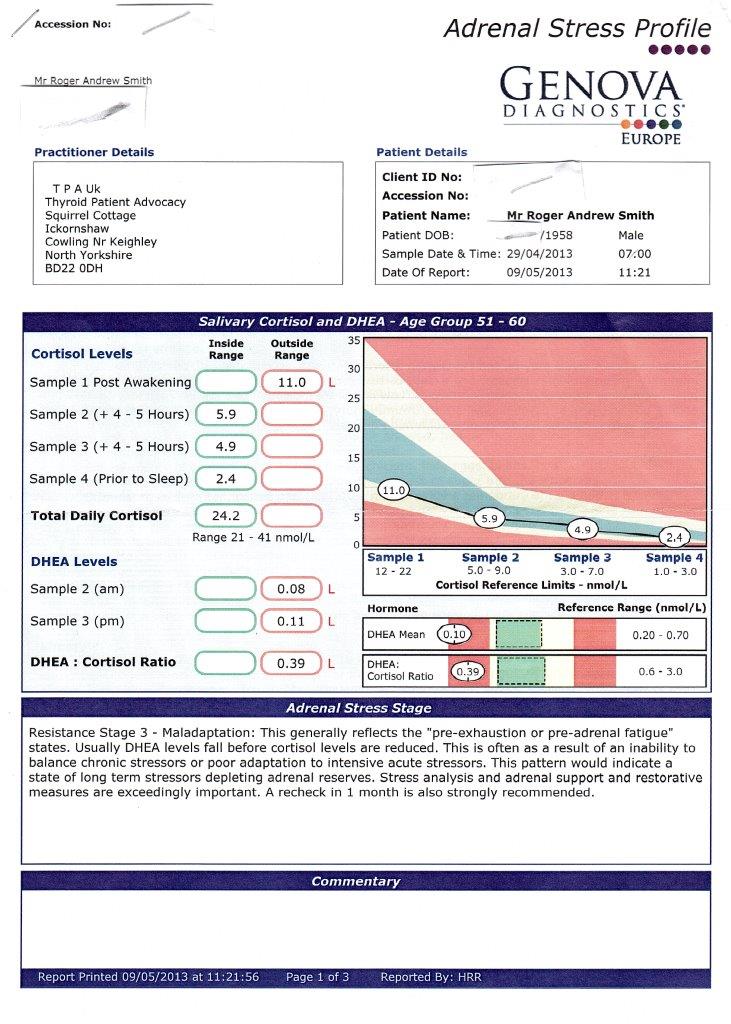
  •  Adrenal Fatigue Saliva Test: The adrenal glands produce hormones including cortisol and DHEA. These small molecules travel to all parts of your body including the saliva glands. The test involves spitting in a sample tube for laboratory for analysis. This is better than blood tests as it is less stressful and allows for several samples in one day. It is how the cortisol and DHEA vary during the day that allows the precise measure of your adrenal function. One day of testing will confirm your level of adrenal fatigue. Results are provided as a graph, showing changes throughout the day.

My adrenal function test results from April 2013 – click image to see it enlarged:

adrenalbipolar

Adrenal function test results

Cortisol is naturally high in the morning and decreases towards bedtime. If it does not start high enough or drops too rapidly you have most likely got a problem.

DHEA is so central to hormone production that a good level of this is needed at all times. Low results indicate lifestyle changes (perhaps better diet and more rest) are needed.

This test may be better described as a test for Adrenal Dysfunction as the test tells us about how our adrenal glands are performing rather than being directly related to how fatigued you are feeling. Adrenal dysfunction means your energy levels stop matching what you need and when you need it. Dysfunction eventually leads to fatigue.

What does all this mean?

  1. Nobody, not even you can prove you have a disorder called bipolar.
  2. Doctors can measure and say for certain how your adrenal glands are performing and if under-performance is affecting your mood.

If you have been diagnosed/labelled with bipolar, schizophrenia, depression, chronic fatigue syndrome, M.E. or similar then ask your doctor about having your adrenal glands tested through saliva testing. If your doctor says, “No” then consider paying for this test. I think it cost me about £80. If you want me to look up exactly what I paid and where I had the test done, then contact me through the comments option on this blog or through www.rethinkinghealth.co.uk

Bipolar or Adrenal Fatigue – Part 3 of 3

There are many conditions that lead to bipolar diagnosis. Adrenal dysfunction is just one possibility as discussed here in response to a member of the Institute of Optimum Nutrition.

Thank you for your useful contribution to my comparison of adrenal dysfunction with bipolar diagnosis.

Poor diet is one of the main causes of mood disorder, so the link to the Institute of Optimum Nutrition is going to help a lot of readers. The nutrients mentioned are all important and as you know there is a lot more about our diets that need to be taken into account. Moving on from a bipolar diagnosis will involve dietary improvements as part of a recovery plan.

In saying adrenal fatigue is mistakenly being diagnosed as a psychiatric disorder I was very much thinking all forms of bipolar other than the old manic depression diagnosis that involves people getting extremely busy, having grandiose plans and as you say, “have enough energy to rush around.” This state is described as mania and may also involve noticeable loss of touch with reality, with delusions and/or hallucinations.

In the more modern forms of bipolar, which are now by far the more common diagnosis, there is a much closer match with adrenal fatigue. With the Bipolar 2 diagnosis the patient has long periods of low energy and negative feelings, with short-lived periods of having a little more energy often not even noticed by friends and relatives. With another form of bipolar called cyclothymia the periods of low mood are not usually disabling but just keep on happening, and again without any extreme highs.

What I have noticed is that like me, people may initially see a doctor when having plenty of energy and asking for help, but after several years of involvement with psychiatry the high energy periods become shorter and less extreme until the pattern of moods looks more like on-going fatigue.

I am sure we are agreed that Adrenal Fatigue is best not described as a psychiatric disorder. I am hoping is that my articles will remind doctors that there are many reasons for apparent mood disorders. The other imbalances you mention (hormones, nutrients, food intolerances, blood sugar) do cause imbalanced moods and do need to be addressed first along with external stressors.

Most people who start off appearing to ‘be bipolar’ eventually end up fatigued and coping with exhaustion becomes our biggest daily challenge. (As discussed elsewhere sedative psychiatric drugs can cause more fatigue.)

Too often a bipolar diagnosis is given without looking for other possible causes. Adrenal Fatigue is just one of these possibilities and there are many more that I wish could be checked out before psychiatric labels are considered.