People with hope recover after a bipolar diagnosis plus Suzanne Beachy – What’s Next For The Truth

This I found out a long time ago:

People with hope recover after a bipolar diagnosis.

People who keep on having their hope taken away do not recover.

In 2010, Suzanne Beachy got up on stage to say about being the mother of a young man who was told he would never recover. The doctors who told him that he would never recover were right. It is very difficult to recover when your doctors are the ones taking your hope away. The young man died and the mother investigated. In sharing the truth she ends with these words,

Insanity: Doing the same thing over and over again and expecting different results.” – Albert Einstein

The facts she presents are about recovery from having psychotic episodes and after schizophrenia diagnosis.  This information is all widely known among those working to help people recover. What perhaps is less well-known is the same is true for the bipolar diagnosis. It is not something special about schizophrenia. All these emotional difficulties can be overcome when there is appropriate support from family and professionals. Firstly, family members need to take time to learn about emotional distress and realise that all the ‘symptoms’ are simply indications of the distress and are not coming from an illness.

Here is the video. Settle down as it worth watching the full 20 minutes and remembering that what happened to the woman’s son is happening all over the ‘developed world’ right now… over and over again.

Suzanne Beachy – What’s Next For The Truth

Do ‘SSRI’ drugs cause some people to drink more alcohol? #ssrialcohol

According to an article posted yesterday by the very respected Dr David Healy it seems that people are drinking more when taking drugs known as ‘SSRI antidepressants’, such as paroxetine, citalopram and seroxat. Apologies to readers who are using these, just that it seems better to know about the risks.

Warning: Suddenly stopping any psychiatric drug typically results in very unpleasant  feelings, changes in energy levels and the potential for distorted thinking. There is a lot of pre-work to be done to successfully come off drugs.

My belief: Most of the damage done by drugs is through taking too much for too long, rather because any one chemical is especially more dangerous than another. Taking a small amount of an appropriate drug every day may in fact be the best way to get through life. If the drug is making you ill, then you need to get help so you can take less of it.

Suggestion: If your doctor will not discuss your prescription with you, think about ways to find a doctor who knows about emotions, medication, risks and the need to help you get the dose right.

Here is the article. The main reason I am publishing this is that I have noticed friends seeming to drink more when they are on antidepressants and then getting worse. It seems to be yet another driver for increasing bipolar diagnosis due to drug plus drink creating greater extremes of mood.

Here is David Healy’s article:

http://www.madinamerica.com/2012/03/out-of-my-mind-driven-to-drink/

Bipolar diagnosis takes years off life #bipolarlife

Warning: Suddenly stopping any psychiatric drug typically results in very unpleasant  feelings, changes in energy levels and the potential for distorted thinking. There is a lot of pre-work to be done to successfully come off drugs.

My belief: Most of the damage done by drugs is through taking too much for too long, rather because any one chemical is especially more dangerous than another. Taking a small amount of an appropriate drug every day may in fact be the best way to get through life. If the drug is making you ill, then you need to get help so you can take less of it.

Suggestion: If your doctor will not discuss your prescription with you, think about ways to find a doctor who knows about emotions, medication, risks and can help you get the dose right.

Some say bipolar diagnosis takes 25 years off life expectancy

I didn’t want to have to say any more about psychiatric drug risks at this time. The trouble is doctors do not seem to be aware of the risks.

There are many reasons why the people diagnosed with bipolar tend to die younger than people with similar emotional distress who avoid diagnosis. From scans of brains damaged by prolonged use of psychiatric drugs we know drugs contribute to early death.

Here is a quote from and a link to a recent article discussing research into early death among those who take psychiatric drugs…

…second-generation antipsychotic drugs can trigger metabolic syndrome, which is associated with a two- to threefold increase in death from cardiovascular disease and a twofold increase in deaths from all causes combined.

from Dr Jane Collingwood’s article: Premature Death Rates Rising in Schizophrenia, Bipolar Patients

Doctors need help in understanding how people can return to good mental health without the need to diagnose. Here is a link for: doctors who would like to know more about emotional people getting by without the need for diagnosis and with little need for medication

Bipolar recovery – a professional appearance can help

Regardless of diagnosis professionalism makes us effective

As we start to recover from years of disorder and medication, it is easy to get very enthusiastic and to start to write and write. People diagnosed with bipolar and not on too much medication are often prolific writers. Before the bipolar diagnosis was created in 1980, eccentric or energetic or free-thinking people would tend to write more than the ‘average’ person who would be going to work,  bringing up children, decorating, gardening, playing sports…

As the diagnosis has increased in popularity the ease of creating articles and publishing happens to have also become easier and relatively cheaper.

There is a hazard here. A lot of us are ‘fired up’ with enthusiasm for change and this can lead to quantity-rather-than-quality. Quantity is great and hundreds of articles are now published every day as we share what we have been through, what we have discovered and how urgently change is needed to stop more people dying needlessly from the bipolar disorder diagnosis. However, if we are to be effective quality is essential.

Two thoughts on improving quality of articles written by ex-bipolar people:

1. Who is checking what we write before publication? Editors are hard to find. I mainly get feedback from friends after publication. This is not ideal. New readers see mistakes and this does not help to build trust. Sometimes something as simple as a word word put in twice can distract enough that the main message gets ignored.

2. Appearance is sometimes as important as the words. Colourful, bright, enthusiastic can be good, but overall it is a professional look that is usually needed if we are going to communicate with the professionals who have influence.

One change I have made today is to pay Word-press to remove the irrelevant adverts that were being posted here.  A strange thing to need to do, but I believe well worth it as readers will be able to give their full attention to what is being said.

I am looking for volunteers – if you spot errors in my posts or pages anywhere on the internet please  let me know. I need an improving reputation if I am to persuade doctors and psychiatrists to start rethinking bipolar and seeing the very emotional people behind the diagnosis.

If you are working on eliminating bipolar or recovery, I may be able to return the favour and review articles for you.

#ADHD and #ODD can be a way of getting the brainy ones to conform, but…

This site is about rethinking bipolar, so why the interest in ADHD (Attention Deficit Hyperactivity Disorder), ODD (Oppositional Defiant Disorder) and all those other mood disorders?

Could it be that all these diagnoses are just different ways of describing the same troubles?

Some people are emotional and some people are very emotional. When the world around us does not seem to be the way it should be, some of us become increasingly emotional. On our ‘understanding mood‘ course we share a view of how powerful emotions cause kids to start thinking too much. Unfortunately many schools and workplaces are not geared up for those who are ‘thinking outside the box’.

There is now a trend towards diagnosing everyone who challenges authority as mentally ill. In 1980 the ADHD diagnosis was created allowing children who are not fitting in with their family and school to be medicated with drugs such as Ritalin. Ritalin is a stimulant drug which over time tends to increase ‘manic behaviour’ and the likelihood of bipolar disorder diagnosis.

It is another driver for the bipolar boom

This is the article I read this morning that got me thinking about this. It is rather good:

Einstein: Being anti-authoritarian is being seen as mental illness

Choose your mood

For more than a year I have asked training course participants if this statement is ‘true’, ‘false’ or ‘maybe’…

“I choose my mood and am in the mood I want to be in most of the time”

I have been surprised that many nurses, social workers and similar participants say this is not true for them. They then say it is not true for the people they are paid to help.

Surely we should be able to choose our mood most of the time. If we find that our moods are almost entirely depend on our circumstances there is a huge risk that we could become increasingly unhappy and dissatisfied.

If we are going to help others recover from mood disorders and help others with choosing their moods we first need to practice choosing our own moods.

We can help clients, friends and family better when we are able to choose our own moods.

See: What is emotion?

New Bipolar Disorder handbook Published 2012

Bipolar Disorder handbook – Pavilion Publishing 2012bipolar disorder book

Danny Walsh and I started writing our book about bipolar disorder and how people with the diagnosis can best be supported about five years ago. It has at last been published!

The views in the book are kind of steadier and fit in more with current practice than you might expect if you are a regular reader of this blog. There again we feel confident it is the most up to date chunky book on bipolar, so if you need to know a lot about bipolar for your job or because you are living with someone with the diagnosis then it is going to be worth having a copy.

I am not saying this for financial gain as Danny and I have been paid a lump sum for creating the book, so there are no royalties from increasing sales. I am simply letting you know that this book exists and can be purchased through:

Pavilion Publishing

 ISBN: 9781908066152

“Mentally ill” – How does one clear one’s name?

In January 2012, I asked psychiatrist,  Dr Hugh Middleton for his views on ‘undiagnosis‘. This led to this question:

Once identified as one with a mental health difficulty (or even worse in some ways, a specific diagnosis) how does one clear one’s name?

Starting with Hugh Middleton’s thoughts on this subject I hope you will agree the following is realistic, useful and worth passing on as it points a way forward in reducing stigma and suffering: 

It involves being able to walk away from all the fuss others make about it.

A truly “recovered” position is when the causes of the distress do not matter any more. Unfortunate or traumatic things happen to us all. These can cause a change of direction or other lasting consequences, such a failed relationship being painful and necessitating changes to allow new possibilities.

The idea that an episode of disturbed behaviour somehow marks the person as inevitably and eternally flawed is a primitive one based upon archaic notions of mental stability. Long after a diagnosis, if one is no longer distressed, anxious or a source of concern to others, then it is only a problem if people relevant to you still believe there to be one.

Bereavement is a form of emotional distress but few would say it is a ‘mental illness’. Most people eventually move on in some way, even after a period of great emotional distress through bereavement. Having got ourselves together again, there is no question of ongoing abnormality for having been through this experience. Occasionally someone may not fully recover from a particular bereavement: I know a woman whose daughter was killed and naturally she suffered extreme emotional distress. Then her physical health rapidly deteriorated and 30 years later she is still very unwell. Even such a sad outcome did not result in a mental health diagnosis and she able to get by with support from understanding family and friends without any the stigma commonly felt for life by those who have been given a diagnosis.

When emotional distress is labelled as ‘severe mental illness’, the public (to some extent that is all of us) can associate the label with manifestations of extremely disturbing behaviour. It is difficult to shrug off terms such as ‘psychotic illness’ and move on from it.

Rituals that help people to move on after bereavement are well-known, such as the funeral, disposing of effects and making new friends/relationships. People who have suffered all forms of emotional distress have always had ways of coping and moving on if they are allowed to do so. Since the 1980’s it has become increasingly popular for those who make good recoveries to document and share these through books and training courses. How recovery happens is certainly not a mystery, as simple concepts and methods lie at the heart of these accounts of recovery. Unfortunately alongside this increased focus on recovery is a modern belief that ‘in-recovery’ is the only state worth aiming for and healthcare staff now often shy away from talk of ‘full recovery’.

Involvement with anti-stigma work has led me to doubt that this can have much effect until healthcare staff can get over the ‘in-recovery-forever’ idea. The public can be influenced by celebrities who appear to be in-recovery, but the people most of us look to for guidance about what is possible are the health professionals. It is they who need to return to the roles of the pre-drug era where belief in full recovery was widespread.

Ultimately, recovery from emotional distress will return to normal when we can all stop calling it ‘mental illness’. Hardly any of the people being diagnosed either have a definable mental problem or a diagnosable illness. Emotional distress is to do with emotions and when people can be helped to understand their emotions and what has caused their distress then full recovery becomes the norm. It is time those who have recovered start to work more closely with the medical professionals who are ready to abolish psychiatric diagnosis.

Roger Smith – based on my conversation with Dr Hugh Middleton in January 2012


Causes of Emotional Distress – Richard Bentall’s work on-line

The Social Origins of Psychosis

Many of the presentations from the Soteria Network Conference, Derby, UK are now available on-line.

I would like to draw your attention to these slide based on 763 research reports from around the world on the causes of psychosis: The Social Origins of Psychosis from Richard Bentall and his team at Liverpool University.

Click on the link and then click on Richard Bentall – Be aware that the slides can take a minute or so to load – it is well worth the wait.

http://www.soterianetwork.org.uk/articles/index.html

It appears that emotional distress and hence what is known as mental illness is due to what happens to us, and so far as anyone can tell there is no direct link to our genes.

This probably comes as no surprise if you have been bullied and abused.

Emotional Health: What Emotions Are and How They Cause Social and Mental Diseases

Emotional Health – Bob Johnson (Author)

This is the review I have just put on www.amazon.co.uk.

Dr Bob Johnson

Emotional Health – Dr Bob Johnson

As with all the best books that are sharing a lifetime’s learning, the basic messages are simple. For me the main message is:

“TRUTH + TRUST + CONSENT >>> allows >>> LOVEABLE + SOCIABLE + NON-VIOLENT”

I have written this inside the front cover of my copy as it is what Dr Johnson has proved beyond doubt throughout his career. I can see how this can be applied to any and every person, any group and to the whole of society/our world.

Some highlights for me include the first sentence of the foreword, “Emotions are the single most vital ingredient in all human affairs.” – This is so true and yet most psychiatrists refuse to talk about anything emotional, which for patients is confusing to say the least.

Page 53 – I like the simple idea that illnesses often/usually become curable once the causes are known. It is the same for just about all physical illness and ‘mental illness’.

By half way through the link between ‘frozen terror’ and addictive behaviour had become a lot clearer in my mind. It clearly explains how so many of us, when not addicted to drugs etc, become addicted to work. It is as if we are too frightened to stop and face our fears. As addictions go, they say that “work is better than whiskey” but sorting out what is causing our addictions has to be better still.

Overall, the book left me with an increased strength in the belief that ‘mental illness’ is an out of date expression as these troubles are all simply different degrees of emotional distress. I am responding to this by increasing the emphasis on emotions in the training I offer. The world is going to be a better place for us all when more people are able to get help for difficult emotions before they start to be labelled as mentally ill.

It is well recognised that effectiveness in the real world depends on having a belief that we make a difference. (This Stephen R Covey describes as the first habit of highly effective people. He says, “Be proactive”.) Dr Johnson steers clear of simply stating that we have free will as that is always being disputed. Instead, a series of discussions to emphasise the diagnostic manual approach of ignoring the mind and treating the brain as simply a clockwork organ has never had any success in reducing the incidence of emotional distress. As a scientist I can understand the reasoning behind the strange idea of, ‘patients are incapable of decision-making’, but in the real world it is plain stupid. Patients invariably want to make decisions, and allowing patients to make decisions is a key factor in all recovery.

I found the first half of the book very powerful as there are many accounts from Dr Johnson’s work in prisons. By describing extreme cases of emotional distressed linked with murder and life-sentences, the links between our own distress and our future emotions become clearer. It can leave no doubt that it is the events in our life we need to look to when considering how happy or sad we are and not anything that could have been programmed before we were born.

There is a lot more in this book and I am sure I will be increasingly making use of the concepts I have read here.

Why would I mark this book as 4 out of 5? A tiny problem I had with the style was the number of words used that just were not in my vocabulary (about 30 in total). Yes, I was able to learn a few new words, by using a dictionary, but it did leave me wondering if the message could have been even clearer if a ‘less well educated’ editor had been employed to kind of dumb the book down for the less academic reader. The other thing I did not like were brief mentions of thermodynamics towards the end of the book. I found these unnecessary. A misinterpretation of thermodynamic principles was disappointing, although I am guessing that non-scientists would not spot or would easily overlook this error

This is an exceptionally good book. A book everyone working in healthcare should make themselves familiar with.

Roger Smith 25th January 2012

Kindle edition on www.amazon.co.uk:
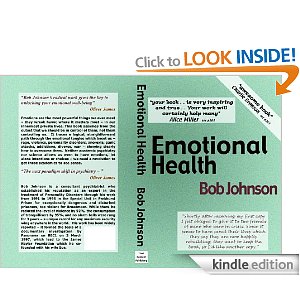
Author Bob Johnson

Emotional Health – Kindle edition

RETHINKING THE BROKEN BRAIN

Little by little psychiatrists are giving in to the pressure to reveal the truth about psychiatric drugs. Which drugs have never shown any benefit? Which drugs cause long-term irreversible damage? This information has been published and it seems it is being suppressed.

Have a look at what: Jonathan Leo, Ph.D. (Professor of Neuroanatomy) and Jeffrey Lacasse, Ph.D. posted on line yesterday (23rd January 2012) – Psychiatry’s Grand Confession

There is a long way to go in the UK where it is likely 98% of NHS psychiatrists still favour hiding the truth from patients and relatives.

Does your GP know that psychiatrist explain a ‘model’ to patients even though it is contrary to the scientific facts. Please pass on articles like this to your doctor.  Thank you.

Ups and Downs – Rethink Survey

This post was about the survey I helped to design for ‘ Rethinking Mental Illness’ that was live all through January 2012. Our aim is to understand and report on the treatment and support people have when they are feeling ‘up/high’ and ‘down/low’. This is for people with personal experience of using mental health services, AND FOR PEOPLE IN SUPPORTING ROLES.

I will be putting some results from this survey here soon.

Schizophrenia Commission – survey

The Schizophrenia Commission are conducting  a comprehensive review of schizophrenia and want to know what it means to you today.

This survey is available at http://www.schizophreniacommission.org.uk or by simply clicking on http://www.surveymonkey.com/s/szcomm

If just ticking the boxes it takes 10 minutes. I found the questions fascinating and spent longer on it answering in the optional text boxes. I think you will find completing this survey well worthwhile – it certainly got me thinking.

An excerpt from “The Cure for Mood Disorders Is Dementia?”

This is an excerpt from the article I was reading this morning. Really, I am keen to be sharing how people recover and minimise medication. I am keen to share how people can avoid getting the diagnosis, but these drugs are worse than most people realise and… well, I am not going to say any more here – let me know what you think:

Should studies that show (prove?) that atypical antipsychotics cause dementia be shared or suppressed?

Article by: 

“In February 2011, Ho, Andreasen, Ziebell, Pierson, and Magnotta documented the brain volume reduction among their patients taking drugs that block dopamine, which includes the older antipsychotics and the newer atypicals. To prove causation, subjects have to be randomly assigned to a particular treatment or a control group. Fulfilling that requirement can be difficult with human subjects. So for proof of the causal connection, Ho et al., cited animal studies which observed the necessary random assignment. Researchers randomly assigned monkeys, none of whom were suffering from psychosis, to receive or not receive anti-dopamine drugs for two years. The animal researchers found that the antipsychotics do result in brain volume shrinkage. These results are consistent with what is known about brain health generally. Dopamine is a trigger for the release of growth factors in brain. If you block the dopamine message with a drug that sits on the receptor, there will be less release of growth factors, and poorer brain health.

Of course, brain volume reduction is only the latest, most awesome problem with the atypical antipsychotic drugs. From the outset, it has been known that the atypicals are associated with significant weight gain, diabetes, and high levels of fat in the blood. Moreover, atypicals are associated with QT wave prolongation (capable of inducing a heart attack). So if you take seroquel for sleep, you might be sleeping for longer than intended.

When drugs are approved by the FDA, they are evaluated for damage to major organ systems. Unfortunately, the drugs given to change mood and behavior are not evaluated for damage to structures in the brain.”

Read full article at Mad in America

Prof Bentall – rethinking the causes of emotional distress

At the Soteria Network conference – Derby 2011, Prof Richard Bentall was the last speaker. Unusually for a conference people were not sneaking out one by one to catch trains home. Prof Bentall was brilliant! He knows his stuff.

I have noticed this article of his is being circulated on the internet. Re-reading it, I can see why. Even if you have read this before it is worth sparing 5 minutes. It is just 1,000 words and yet says so much.

http://www.guardian.co.uk/commentisfree/2009/aug/31/psychiatry-psychosis-schizophrenia-drug-treatments