The smoking of psychiatry

The debate about whether psychological problems are caused by trauma/abuse OR by our chemistry OR by our genes has been going on for as long as I can remember.

Here Simon Hatcher reminds us that childhood abuse is a major reason in causing psychiatric problems. He likens this abuse to smoking that beyond doubt causes disease.

http://www.thementalelf.net/populations-and-settings/child-and-adolescent/childhood-trauma-and-abuse-is-the-smoking-of-psychiatry/

In a very different article Ken McLaughlin says “This social preoccupation with abuse, and the way people are encouraged to interpret their current problems through the prism of past sufferings, should be of greater concern than anything DSM-5 might come up with.” – This is from a longish article which left me feeling that Ken has not met as many people as I have who have never doubted that abuse in childhood was the main reason leading to psychiatric difficulties. If you have time his article is here…

http://www.spiked-online.com/site/article/13621/

Or read what Judith Haire has to say in response to Ken McLaughlin’s “Our brains aren’t moulded by abuse”

http://dawnwillis.wordpress.com/2013/05/21/judithhaire-comments-on-ken-mclaughlin-our-brains-arent-moulded-by-abuse-mentalhealth-ukmh/

Different groups have different things to gain from convincing us that their preferred explanations are the most valid.

My own experience and what I have learned by listening to hundreds of people and reading widely is:

Genetics pretty much have nothing to do with causing us to come in front of psychiatrists. No one is immune and the trend is towards every family being affected by poor mental health. As discussed before at Rethinking Bipolar the claims of links between genes and emotional distress have never been backed up by any other group doing similar research anywhere in the world. There is however no single cause of mental distress and often there are multiple triggers.

Trauma/abuse sets millions of people up for struggling with their emotional health for decades after the event(s). Sometimes it is recognized as Post Traumatic Stress but usually it is not so clear-cut.

Our biochemistry is a huge factor in determining our mental health. Our mental health also affects our biochemistry. DSM-5 is essentially the drug company’s brochure and main marketing tool. The problems we have with our body’s chemistry rarely need the high-tech, complex solutions the drug companies would have us believe. Next time you are sitting with someone who is keen to talk about their emotional difficulties take a look at them. Chances are they will not be looking particularly physically fit. Trauma and abuse makes us more susceptible to less healthy life-styles and then life-style drives both our physical and emotional health – in the wrong direction.

I think all our authors and just about everyone involved with sorting out emotional health problems know that both trauma/abuse and chemistry are involved. The debate as to which is more significant will continue. What I am hoping can be accepted is that both are always involved in some way. Even in the cases cited by Ken McLaughlin where people say they were abused but will not or cannot talk about what happened, I feel sure things did happen that influence them towards the troubles they end up in.  The fact that some or even a great many people suffer extreme trauma/abuse and have never had to see a psychiatrist is perhaps a testament to healthy life-style, good relationships  etc being protective factors.

What I have consistently noticed is that those who feel they were traumatized/abused who then went on to make poor lifestyle choices and without the right support things got worse for them.

Poor lifestyle choices? I read an article this morning about some mental health issues causing sufferers to die 25 years earlier and the likelihood that this is largely as a result of psychiatric drugs and not just a direct result from poor mental health and poor lifestyle choices.

Summary: Trauma/abuse with insufficient support > poor lifestyle choices > poor chemistry > stress > diagnosis > a need to discuss earlier problems which may be to do with past events OR maybe what I help people with, which is in addressing current lifestyle to correct biochemistry without the need for DSM-5.

*Biochemistry:  http://en.wikipedia.org/wiki/Biochemistry

You did not have bipolar disorder after all #bipolarlabel #bipolardiagnosis

A few weeks ago a reader added this comment,

People who recover after a bipolar diagnosis are ones who never truly had bipolar to begin with

David is not the first person to say this to me. It is certainly an idea I have thought about a lot. It is a fair comment as those who are convinced they have a disorder without recovery, rarely make good long-term recoveries. Certainly, recovery can be limited by anyone who tells us we have a specific disorder and by those who say, ‘No one ever fully recovers.’

Around the world, millions of people are being mis-diagnosed without much evidence of extreme manic and depressive episodes. I was told I had manic depression then told I had bipolar. The drugs I was told to take for bipolar helped me feel better for a while then gradually made me less and less well. The drugs eventually became the main cause for my worsening symptoms. To survive I had to take less drugs. Eventually my doctor said I did not need the psychiatric drugs at all.

Just a few days of using the Mood Mapping grid is all it takes for most people to realize they are not so bipolar after all. Using mood mapping reminds us that we all experience a range of moods and we find bipolarity is still very rare. There certainly is no clear-cut line between a ‘bipolar person’ and a ‘non-bipolar person’. Everyone has emotions and everyone can struggle with their emotions but while there is a diagnosis of bipolar there will always be people who can accept the label and others who reject the label.

I was taking the psychiatric drugs; believing in the bipolar diagnosis, attending bipolar meetings, facilitating a group for people with the bipolar diagnosis and so on. I had extremes of mood and there were plenty of health professionals saying I needed the drugs. Like many other people I have successfully withdrawn from the drugs. It was a slow process taking me 12 years. I have changed my life and increased the ways I have cope with stress to do this.

I recognize that a lot of people continue to find drugs a useful tool to help to manage from day-to-day. If; the drugs are helping you feel better, you are happy with your level of fitness and you are fully aware of any long-term drug effects then it is understandable that you want to stick with the drug and diagnosis. If the drugs and diagnosis are not working for you or you find you become troubled by the longer term effects of drugs and diagnosis then it is best not to rule out a change to either/both.

Five Keys to Mood – Adapted from Mood Mapping by Dr Liz Miller

We can do well in life and avoid disorders by paying attention to our five keys to mood and well-being:

  • SURROUNDINGS – Do we have a good enough home in a good enough neighbourhood and do we get outdoors?
  • HEALTH – Are we eating the right things that allow us to be active, sleep well and think clearly?
  • AUTONOMY – Do we have purpose in our lives and are we achieving some of what we want to be doing?
  • RELATIONSHIPS – Who are we supporting and who supports us?
  • EDUCATION – What do we know and what can we share?

We get over disorders by:

  • spending time in SURROUNDINGS that suit us
  • looking after our physical HEALTH
  • keeping HOPES alive and being able to ‘do our thing’ including being creative or productive
  • paying attention to our RELATIONSHIPS
  • continuing to LEARN and adapting to a changing world

Possibly you have only been paying attention to some of these keys to mood and well-being? This is okay because many people get by focusing just the things they feel are key for them.

What we believe is that sometimes it is necessary to re-look at the FIVE KEYS TO MOOD as part of restoring BALANCE to our lives.

Mood Mapping – Dr Liz Miller – About the Mood Map grid

Dr Liz Miller’s book, Mood Mapping – Plot Your Way to Emotional Health, has two main themes:

    1. The Mood Map grid
    2. The Five Keys to Mood

The Mood Map grid is a simple, visual way to understand and record the way you feel.

It can be used to explain why some of us can be convinced we are ‘bipolar’ and how many of us are coming to realise we never were that ‘bipolar’ at all.

If you want to understand your moods or think your bipolar diagnosis may not be right then the Mood Map grid is the place to start in understanding what is going on with your feelings and moods and how to live a life without being so ‘bipolar’.

Marian Moore says, “Mood can change in an instant or gradually over time. Some people are ‘morning people’, others more nocturnal. Some days are better than others. Mapping your mood helps you see when you are at your best, your worst, and even when it might be better just to stay at home!”

Mood Mapping allows us to increase our self-awareness by allowing us to know more about how we feel and gives insights into why we do the things we do. It develops our observing-self, enabling us to see moods or emotions for what they are, and not being caught up and overwhelmed by them.

Why map our moods?

Stress, anxiety, exhaustion, and depression have always been difficult to quantify and many people find it difficult to say which of these they are experiencing. Yet without measuring these, it can be difficult to know whether things are changing much at all.

Music may help you feel better, but how much better? Is quiet meditation more effective for you? Can this effectiveness be measured and described to others? Which foods improve your mood? Without an effective way of measuring mood it is difficult to know what is affecting your mood most.

By knowing and being able to accurately describe our moods we can become better at helping ourselves and finding the help we need when we need it.

Mood Map grid

Mood Map grid

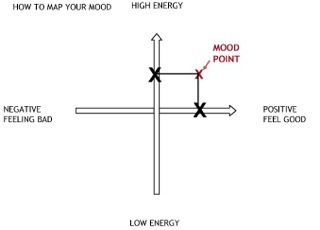
The Mood Map grid as originally developed by Dr Liz Miller:

Mood is said to have two main components:

ENERGY – shown as up and down on the map

POSITIVITY – Essentially how you feel, shown as left and right on the map

The two axes divide the map into four quarters which describe the four basic moods;

  1. Tired (which can include good reflective moods as well as normal exhaustion and abnormal depressive states)
  2. Anxiety
  3. Action
  4. Calm

Moods affect not just how a person feels but also how they behave

For example, a small child runs towards a busy road;

–       a person who is very TIRED may think “How awful, that child may die, I wish I could do something”

–       a person who is already in a mood of high ANXIETY may panic and scream.

–       a person in the ACTION mood – runs to the child and whisks them away from danger.

–       a person who is CALM can think how to avert the danger without unnecessarily alarming people.

In this example the positive moods of ACTION and CALM seem great. The reality is that there are no good or bad moods. There is a time and a place for every type of mood. As we learn from Mood Mapping, it is the ability to change to the mood we need at any particular moment that allows us to be healthiest and work well with those around us.

A Scientific Perspective

Mood most likely comes from the deepest part of the brain, where the sympathetic (flight and fight) and parasympathetic (housekeeping) part of our nervous system join. Thus when we wake up, we immediately become aware of how we feel, and then the rest of the brain can gradually work out why we feel that way, and what we are to do next.

Mood Mapping is a simple technique that is easy to learn and easy to teach.

The first step is to plot your mood at this moment by estimating how much energy you have and putting a mark on the vertical axis.

Plotting on mood map

Plotting on mood map

Then estimate how good or positive they feel and plot that on the horizontal axis. The Mood point is where vertical and horizontal marks on the graph cross.

The Mood Point can be labelled with the time and perhaps a quick note why you feel the way you do. If you feel this is not the right mood for you at this time then maybe think what you have done in the past that has helped you get the mood you want now.

Plot another point later, to see if your choice has been effective.


Thanks to Marian and Liz for allowing me to adapt their article from http://www.krysan.org/index.php/holiday

This is just the start of Mood Mapping. Next article: The Five Keys to Mood

MILLER, LIZ Dr., (2009), Mood Mapping: Plot your way to emotional health and happiness, pub. London, Rodale

No health without mental health

“No health without mental health” is a really catchy slogan that most people seem to grasp quickly. This is a first class article about what this means in the UK at this time, with mental health estimated to be costing £105,000,000,000/year!

http://www.telegraph.co.uk/news/uknews/9928516/Its-time-to-end-the-NHS-bias-against-mental-health.html

Meeting and working with health professionals who know mental health and  physical health are inseparable has opened our eyes to a new way of thinking that is beyond the current “no health without mental health” slogan.

We want to work towards ending the strict segregation of physical health and mental health that delays treatment and excludes many who are labelled as mentally ill from essential National Health Services.

More people are being labelled as BAD! – Bipolar Affective Disorder

Bipolar Affective Disorder = BAD, was created as a new category of ‘mental illness’ in 1980 by its inclusion in the Psychiatrists’ Diagnostic Manual. Prior to 1980 almost no one had heard of bipolar disorder. A story was created saying that this ‘illness’ was simply the renaming of manic depression and gradually more and more people came to believe this story.

Manic Depression was a very rare diagnosis. Bipolar is not just common, it has become an epidemic.

From one person in 10,000 being affected, psychiatry now claims that about 1 in 4 people are now in the bipolar spectrum and the number affected is increasing. Strangely, we are also told it is genetic. The story just does not make sense. A genetic problem does not go from 1 in 10,000 to 1 in 4 in one generation.

What is really going on?

Firstly, Bipolar is not an illness or even a disorder. It is a label given to people who have emotional difficulties. Anyone can have emotional difficulties. These tend to be caused by relationships (e.g. a relative dying), where we live (e.g. having your home repossessed), not knowing how to take care of ourselves (e.g. eating too much carbohydrate or not getting outdoors in daylight) and concerns about the future.

People react to emotional difficulties in different ways. For those who are unable to turn to friends and family a coping mechanism is visiting the GP. In the western world GP’s have been told that emotional difficulties are best treated with sedative drugs and readily prescribe these. Unfortunately, despite many unpleasant side-effects these drugs are addictive. Once started most people find they cannot cope without the drugs. Drugs tend to destabilize moods further, such that:

Emotional difficulties >>> a visit to the GP >>> prescription drugs >>> drug induced emotional difficulties >>> visit to psychiatrist has become the most common route into the ‘bipolar club’.

The last step of labeling used to be exclusively by psychiatrists. With getting on for a quarter of the population believing they need a ‘bipolar label’ the psychiatrists have not been keeping up with the demand they helped to create. An increasingly common route has become via the internet. People are looking at lists of warning signs of emotional difficulties that have been relabeled as ‘bipolar symptoms’ and recognize themselves. Well, really it is not so much themselves they recognize but their recent way of living and coping with emotional difficulties.

Having convinced themselves by reading and often completing an on-line ‘Am I Bipolar?’ quiz, they go to see the GP and present their ‘symptoms’ just as described on-line. This describing our life in terms of symptoms tends to convince GP’s who have been trained to believe bipolar is a brain disorder, that the patient has this disorder. The GP may or may not write, BIPOLAR, but tends to allow the patient to leave with the belief they have a mental illness and that they are bipolar.

The idea of ‘I am bipolar’ has spread around the world. This has further promoted bipolar as a disorder people are being born with and something that stays for life.

There are other ways the disorder is growing. For now though:

Explore the idea that bipolar is more of a label than a diagnosis

Bipolar boom continues

Bipolar is booming!

From a few rare cases of manic depression…

…through to the first ‘antidepressant’ induced manias in the 1950’s…

…through to the boom since the bipolar diagnosis was created in 1980…

…through the proliferation of psychiatric drugs creating more mood instability in those ready to try them…

…and now bipolar being seen in people who were previously viewed as depressed, grieving, mal-nourished or simply exhausted…

…WHY? One answer is: There is a lot of money to be made from bipolar!

However, is it not more ethical to help people recover from emotional difficulties and help them avoid becoming part of this sickly bipolar boom?

Feelings, energy and thinking – its normal, not #bipolar

feelings and energy and thinking

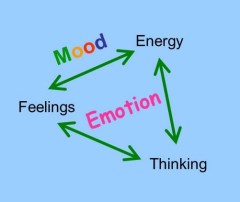
Emotions can be considered to be a mix of our feelings, our energy and our thinking.

Perhaps almost everything now called ‘mental illness’ may really be ’emotional distress’.

Calling it something different does not solve our problems. It is just that when we recognize our troubles are to with emotions rather than being an illness or a specific disorder, then we can help ourselves and help those we care for by gaining a better understanding of emotions.


Governments creating mood disorder? #bipolar

The UK government’s bedroom tax does not directly affect me. Indirectly it does, as many of the people I support are struggling financially and this tax on people who receive housing benefit is already hurting them and some are becoming suicidal.

Example:

A man I know who was ‘down on his luck’ (a victim of the mental illness system) ran out of places he could stay and applied to the local council for a one bedroom place. They did not have anywhere with just one bedroom. They had a two bedroom place he could afford through housing benefit. He settled in and got his moods under control. He could be described as in-recovery. Now things are taking a turn for the worse. The new tax, THE BEDROOM TAX, means that he will lose some of his housing benefit due to having an extra room. I suggested he brick up the room he does not use, or knock the two rooms into one. His tenancy does not allow him to do anything like. He is desperate as he will not be able to pay the rent and there are no one bedroom places for him or thousands of others in the same situation.

Bedroom Tax: It sounds like a joke. What has it got to do with Rethinking Bipolar? I just wanted to give this as an example of the stressors ordinary poor folk are under that the rich psychiatrists are not going to understand. They see disorder as a chemical thing. Yes, chemistry is important, but somewhere safe to live comes first.

Here is a link to the best article I have seen on bedroom tax if you are looking for a way of surviving it, or if you are wealthier (have good contacts) it gives idea for making money from the new tax. Yes, another tax that can benefit those who are already well off. Article: http://speye.wordpress.com/2013/03/07/bedroom-tax-and-lodgers-a-good-idea-yes-from-october/


Profiting from explaining #moods and #bipolar

If you have alwaysFor most of my life I tried. By this I mean that I mostly believed I improved things for myself and others by working hard. I believed that putting in a lot of effort would lead to good things.

In my 2004 book, ‘Stop Paddling / Start Sailing’ I describe this way of living as paddling. The stop paddling idea does not mean to stop making an effort. It is more about seeing the alternatives and then starting again with a better understanding of why sometimes trying hard works well and sometimes it does not work as expected.

By 2005 I was keen to start my training business, with an associate suggesting, ‘Stop Paddling’ as a unique business name. I wanted to help people understand that there are many alternative mind-sets and to help course participants to have more choice whether to spend their time paddling, drifting or sailing and of course to avoid sinking!

The Stop Paddling business did not go as planned and from 2006 to early 2012 I was mainly training people to understand, live with and recover from being diagnosed with bipolar affective disorder. This led to publishing the handbook on Bipolar Disorder for Nurses and Carers in January 2012.

To publish a 350 page book on bipolar disorder and to continue to teach health professionals, the public and of course those who need to recover from the bipolar diagnosis I needed to do a lot of research. I had lots of meetings with experts, read a lot of books, did lots of on-line research and worked for 4 years on mood and recovery research projects.

The authors who I met during this time who most influenced my thinking were Dr Liz Miller and Robert Whitaker (Recommended reading: ‘Mood Mapping’ and ‘An Anatomy of an Epidemic’). If you have time to read both with an open mind you will surely reach the same conclusion I, and I believe everyone else who has read these books comes to: bipolar disorder and other mental health diagnosis are only labels and not medical diagnoses. Bipolar is a label used for people who suffer from stress and anxiety who have periods of higher or lower energy levels.

For earlier generations (prior to bipolar becoming a diagnosable disorder in 1980) most people feeling anxious and stressed with variable energy levels would have been considered to simply be under pressure, in pain, needing change… Now you only need to sit in front of a psychiatrist and say you are feeling troubled for a bipolar disorder diagnosis to be a likely outcome.

This has left me in an odd situation. I continue to research and teach about what is described as a diagnosis that is really no more than a label.

In creating the social enterprise, Rethinking Health (UK) Ltd, my new colleagues helped me find a way to continue with this teaching and research through helping students see both sides of ‘the bipolar coin©’. Part of our courses are delivered using a large coin with each face used for comparison of the main alternative views.

For most who are being labelled as bipolar their biggest challenge becomes the label itself which implies little or no recovery, little hope and on-going stigma that maintains a bleak looking future which in turn maintains the disorder. As well as their original troubles they now have to cope with the stigma that stacks so much against them when wanting to get their lives back on track.

I am reminded of the statement at the top of the page and this quote…

Madness is doing the same thing again and again and expecting a different outcome.” Albert Einstein

Tackling causes:

Whatever it is that is driving people to turn up at doctor’s offices to accept the bipolar diagnosis it will continue to make these people unwell unless something changes. Knowing what to change depends on looking at the causes of our emotional turmoil.

On our recovery courses people have found it easy to identify many possible causes. These are all things that happened in the past that set us up for difficulties with managing our emotions or things in the present that can tip us over the edge.

The likely causes are well-known. It is more challenging, yet essential, to help people to find their personal causes and triggers. Knowing what causes and triggers our troubles allows us to not just to change what we do, but also to have a good chance of making the right changes that will allow us to live a healthier life.

A fresh start:

2012 was a big year for us in figuring out what is going on and how we can help improve the prospects for the next generation.

It was also a time of realisation that we as trainers with experience of mood disorder had become part of the bipolar industry. We were being paid to effectively promote the idea of bipolar as a diagnosis and however much we were explaining that bipolar is just a theory, just using the word was helping the industry around bipolar to keep on growing and drugs to continue to be prescribed.

Although we cannot challenge bipolar without using the word ‘bipolar’, it now seems more ethical not to take a wage from this but rather keep the money we are paid in the social enterprise. This is  allowing our work to expand and so more people can have more hope after bipolar diagnosis.

This is a different kind of profit – if we can do this we can start to feel great about our work again.

What are we recovering from? #bipolar #anxiety #grief

Full recovery?

People have always recovered from mood disorders. We get anxious then get less anxious. We feel exhausted, then after a rest feel energetic again.

Is it fair to talk of ‘full recovery’? Does anyone ever fully recover? Maybe it all depends on what we believe we are recovering from?

For thousands of years it was considered normal for moods to vary throughout each day. During the 20th century a new idea formed that any more than small changes in mood were a sign of illness. By 1980 this idea allowed the new diagnosis/label of bipolar disorder. Gradually the meaning of bipolar has expanded such that only those whose moods hardly change at all can be sure of not being described as bipolar.

If we step back from the idea of most of us having mood disorder and think about what caused our moods to appear disordered, then by tackling the causes we can expect to recover. If, in our minds, we can very nearly eliminate the original cause then we can very nearly eliminate its effects on our moods.

For example, after a relative died I saw a psychiatrist. I had never met him before. After our 50 minute meeting he wrote to my GP to say that in his opinion I was suffering a mood disorder and in his opinion I was a catatonic schizophrenic. I got over my relative dying (I just have a little cry now and then) but getting over a label like catatonic schizophrenic takes a lot longer. It is a shame the psychiatrist was not able to simply write that I was grieving.

Full recovery used to be defined as being able to get back to what you used to do. Theses days I wonder if it is more about being able to move on to what you want and need to be doing.

#Bipolar or Spiritual Awakenings – Sean Blackwell

Am I Bipolar or Waking Up?Am-I-Bipolar

Author: Sean Blackwell 2011

After a powerful emotional experience Sean Blackwell was sure he was destined to be something other than a Canadian advertising man. Sean describes a close shave with death that may have contributed to what many would have seen as a manic episode. The autobiography unfolds with many seemingly chance encounters leading to the start of Sean’s new life in Brazil.

This is an exceptionally well-written and enjoyable autobiography. If you know of Sean’s current work you will have a good idea how the book ends, yet Sean tells it as it happened with only vague insights into what the future would hold for him.

Reading about ‘spiritual awakenings’ and how young people are being ‘stamped’ with the bipolar label in North and South America, has got us wondering how often manic episodes would be better described as Emotional Awakenings.

Emotional Awakenings: It seems young people who are trying to live the life others expect of them can quite suddenly have a wave of extreme emotion accompanied by bizarre behaviour. Yet, with good support people come through this without a mental health diagnosis, without psychiatric drugs, and often with a new sense of purpose.

In this book we are reminded, “The number of American children and adolescents treated for bipolar disorder increased 40-fold from 1994 to 2003” – Benedict Carey 4th September 2007 – NY Times

‘Am I Bipolar or Waking Up?’ by Sean Blackwell is full of hope and needs to be read by every parent in the western world if the bipolar epidemic is to brought under control.

Find out more at: www.bipolarORwakingUP.com

Causes of mood disorder and advice that works – Avoiding: #bipolar #schizophrenia

When we start to understand the causes of our troubles we have a better chance of doing things that make these troubles less likely or not so damaging.

If we are going to get to grips with our mood we need to know what causes shifts in mood.

  • Unpleasant high energy states that can give rise to being labelled with schizophrenia seem to come from in trauma and abuse. Trauma and abuse comes in many forms and can happen in any period of our lives.
  • Pleasant high energy states (described as mania) often happen as we realize possibilities for positive change. The root of this can be an overwhelming desire to escape from a lifestyle we feel we have been forced into.
  • Exhaustion often follows on from high energy states and this is often labeled as depression.

The extent and duration of mood problems seems always to be linked to food, drink and drugs. In fact how the problems proceed is always affected by what we do with our mouths. Do we take tablets to try to make the troubles go away? Do we drink loads of coffee to stay awake to try to solve whatever is bugging us? Some options prolong the troubles and in themselves become the cause of further mood disorder.

One person’s thoughts on a way forward:

1. Good nutrition is the key to good health. This is true for mood management too. Eating good food usually helps when we are choosing the moods we want or need to have to stay well.

2. Examining our past can help with understanding. Dwelling too much on the past can be unhelpful. A quick look back every so often may help with avoiding future troubles.

3. During troubled moods we may think too much about the past and the future. The reality is whatever is happening in the ‘here and now’ will be having the greatest influence on your mood today.

4. Recognizing you are not in a mood that is good for you and quickly changing it is a skill. It takes time to learn what works for you. We each need a unique toolbox of ways to stay well. I have needed to keep learning these ways to wellness by watching and listening to those who have been through this recovery process before me. When I have been well enough I have read and learnt a lot that way.

5. There are times when whatever we do does not seem to get us out of the mood we are in. Even I still get ‘stuck in a rut’ from time to time. The thing to remember here is that what you do today is going to have a big influence on your mood tomorrow. For example: A home cooked meal from fresh ingredients today may just give you the nutrition you need to think more clearly tomorrow.


The Myth of the Chemical Cure – Joanna Moncrieff – #antidepressant #neuroleptic #moodstabilizer

The Myth of the Chemical CureJoanna Moncrieff

By Joanna Moncrieff 2008

Review and thoughts on the revised edition 2009

You may have wondered: How effective are psychiatric drugs?

After reading this excellent 300 page Critique of Psychiatric Drug Treatment I know the answer depends on what we mean by effective. Dr Moncrieff explains most of the psychiatric drugs are effective sedatives, yet psychiatric drugs are not resolving any specific mental health disorders. This matches the findings of every psychiatrist taking a look at the evidence.

This soundly researched book takes us through how psychiatric drugs came into use, the hopes for each drug, what the drugs are claimed to do and what the drugs really do.

Chemical imbalances may exist for reasons such as poor nutrition, but there is no evidence of the imbalances being linked to particular diagnoses or that these can be corrected by the use of psychiatric drugs. In contrast, there is evidence of the drugs creating imbalances and users becoming more unwell.

For me, the central theme of this book is whether:

a)      Psychiatric drugs are simply mood altering, addictive drugs with similar effects and outcomes for users as illegal street drugs. This is the ‘drug-centered model’ believed by most professionals and the public up until about the 1960’s.

Or

b)      The disease-centered model populararized by the promotion of ‘new’ drugs marketed with descriptions of what the drug companies hoped the drugs would do.

The drug company (‘big pharma’) records show that (a) is true. The drug names were based on hopes and not on science. None of the drugs were ever proved to have specific anti-depressant, anti-psychotic or mood stabilizing properties. Governments and the public so much wanted to hear about new ways of treating mental illness that improbable stories of social and relationship problems being solved by using new expensive drugs were accepted as true.

The sad reality is that each drug brings with it a set of health risks, described as side-effects. As Dr Moncrieff explains, these are simply effects that occur to some extent for everyone who uses drugs that sedate and gradually change our biochemistry.

If you are on sedative drugs at this time this book is going to be a huge challenge with its attention to detail, with (it seems to me) ‘no stone left unturned’.

The use of psychiatric drugs is now so widespread every healthcare worker needs to know of the short-term and long-term effects. If you are working anywhere in health services or have relatives taking psychiatric drugs then this book is essential reading.

Highly recommended.

Available from:

[Amazon in UK]  [Amazon in USA] [More on Dr J. Moncrieff]

Petitions against #DSM5 #DSM-5

There are probably lots of these petitions underway now. I just want re-blog the link to the one Jeff mentioned as the link did not work for everyone first time around.