#Antipsychotics – Long term effects #Electroboy

Like many of us who agreed to take ‘anti-psychotics’ Andy Behrman (Electroboy) has changed the way he thinks about these.

Since publishing Electroboy speaks out I have been asked about research into how people who have taken these drugs for years cope when they eventually get off the drugs. I do not think there has been much research – as a reader can you tell me of some?

My own personal experience is that it is tough. In many ways my life has been more difficult since my first day visiting a psychiatric ward and being given a small cup of orange liquid and a nurse saying, “Drink this. It will help you feel better.”

It was years later that I discovered the cup contained chlorpromazine. That drink was a turning point in my life as when my parents came to visit me I was suffering memory loss and confusion from the psychosis it induced in me. The effect of the drug was to convince them that I had become severely unwell. It was my first and to date most severe experience of psychosis… But then surely an ‘anti-psychotic’ is supposed to lessen psychosis and not cause it? Well, not really. As with other psychiatric drugs ‘anti-psychotics’ are essentially sedatives. See: The Myth of the Chemical Cure by Joanna Moncrieff

I am sure such the practice of nurses tricking people into taking their first fix of a drug, (without saying what it is) is now strictly forbidden in the UK. There again  student nurses are mainly just given the drug company information about the drugs and not a chemist’s perspective, so those offered the drugs are unlikely to have any idea just how long-term the consequences of that first dose are likely to be.

So 42 years on I am still suffering everyday from the first addiction to an ‘anti-psychotic’ and from the one started in a more violent way years later… being held down by five nurses while the sixth injected the drug into my bum! The ward manager looked on and seemed to be crying… now I understand why.

I am now getting by without the drugs, but most nights it is just getting by. It does not seem I will ever fully recover from the damage the drugs did to me. If you are thinking that you need psychiatric drugs please don’t rush into getting them. If you have a choice make some lifestyle changes and stay away from the drugs.

Time to move on #foodandmood #anxietynotbipolar

When things get too painful it is time to make changes

From my time on psychiatric drugs I have suffered from bad abdominal pains.

It took a long time and a change of GP to have these pains taken seriously. It seems that most GP’s simply see us as ‘complex incurable mental illness patients, who should not be wasting resources that can be better used on those who are considered to be sane. (Is this unfair on the UK National Health Service?)

My new GP helped me in proving the pains were largely caused by too much wheat gluten/dairy produce/chicken eggs/onion. This combined with too much stress!

Better food choices helped but I was still working too much work and still saying ‘Yes’ to every opportunity that came along.

I was up most of last night with severe abdominal pain. I simply failed to read a food label. Now I know I need to make changes or I’ll end up in front of a psychiatrist again. The thought of more psychiatric treatment is frightening after a decade of relative wellness.

I am going to see a nutritionist privately.  I am grateful for the help from the NHS (three appointments with a dietician and an endoscopy) while realising this is about the limit, for a disabling but non-life-threatening condition.

I am thinking now about how pain can help us to move on. Without ‘listening’ to our pains we would just keep doing the same things and get more and more unwell.

I am left wondering how many others have developed food intolerances after taking psychiatric drugs?

Please share your thoughts on how often there seems to be a link between drugs and long term digestive troubles.

Thank you

Brain disorder or mood disorder #stephenfry #bipolarboom

Does Stephen Fry have a brain disorder?

Moab Is My Washpot

There is a lot of misinformation on the internet about bipolar. Some pages describe bipolar as, “a brain disorder that causes unusual shifts in mood…” I believe this to be incorrect in that bipolar is not a brain disorder.

In the book I co-authored and published… (Bipolar Handbook) we explain that there is nothing different to see in the brains of people who are diagnosed with bipolar disorder compared with those who are not. This is confirmed in the two-part BBC documentary “The Secret Life of the Manic Depressive” (Stephen Fry).

Free BBC booklet: http://downloads.bbc.co.uk/headroom/bipolar/bipolar.pdf
DVD from Amazon: http://www.amazon.co.uk/Stephen-Frys-Secret-Manic-Depressive/dp/B002XT38GO

I have watched the documentaries many times and know if you pause the film while the camera is focused on Professor Nick Craddock’s notebook (during the confirmatory diagnosis of Stephen Fry as a genuine manic-depressive) it reveals the name of the drug that Stephen took when just 14 years old. He describes this drug in his autobiographical book, “Moab Is My Washpot”. Although he did not feel this drug was doing him any good he continued to take it until (in his own words in the on page 11 of the ‘Secret Life of Manic Depression’ booklet) “…age of 17, when I tried to commit suicide and woke up in hospital with a tube down my throat.”

Reading what Stephen says about himself in his books, I am left with a strong feeling that his brain works a bit differently… but there again are we not all different? What I wonder and suggest that taking a psychiatric drug at such an early age made Stephen more likely to be diagnosed with manic depression.

Here are some shocking ideas…

  1. Long term use of ‘antidepressants’ makes us better at being depressed.
  2. Long term use of ‘antipsychotics’ makes us better at being psychotic.
  3. Long term use of ‘mood stabilizers’ makes us better at having more unstable moods.

Does this mean Stephen Fry now has a brain disorder caused by taking drugs at an early age? Well, in the film Stephen has his brain scanned and the conclusion is that his brain looks pretty much like anyone else’s brain. There is nothing to be seen that would show either he was born with a disorder or any disorder has occurred. This matches what is found consistently with brain scans – bipolar disorder is a disorder of moods and emotions and so is not detectable.

Bipolar disorder was introduced as a diagnosis in 1980 and gradually replaced manic-depressive as the term preferred by psychiatry for people WITHOUT ANY DETECTABLE BRAIN DISORDER who seem to experience more extreme moods. It is because there is nothing to see (with brain scans) that is different in the brains of people who are diagnosed as having bipolar compared with those who are not that makes diagnosis so inaccurate.

You may see research that claims differences in brain structure, but with careful examination this is likely to be due to taking drugs such as antipsychotics or having electro-convulsive therapy which does indeed create brain disorder. Once again I suggest reading Whitaker’s ‘An Anatomy of an Epidemic‘ from cover to cover to understand how bipolar has grown alongside the psychiatric drug industry. The scientific evidence is that drugs enhance our abilities to experience more extreme moods and this happens through changing brain structure.

Although rather busy at this time I continue to teach, ‘Understanding Mood and Bipolar Disorder’ for organisations all over the UK. When I am less busy I will be advertising this course through Rethinking Health (UK) Ltd.

Training ourselves to be less bipolar #KitJohnson

I’m plenty old enough to remember Bob Geldof and the Boom Town Rats in their prime and so was especially attracted to this article from Kit Johnson. His explanation of how brains work… it seems very believable to me. And besides, does it matter if his theory cannot be proved. The fact that what he says works makes it well worth repeating. Have a read…

http://kit-johnson.com/silicon-chip-inside-her-head-is-switched-to-overload/?goback=%2Egde_164693_member_162336619

If you are wondering where the idea of ‘the silicon chip inside her head is switched to overload‘ comes from – here is a link to wiki…

http://en.wikipedia.org/wiki/I_Don%27t_Like_Mondays

UK Number One single 28 July 1979 – 24 August 1979

Too much bipolar

Too much bipolar?

I’m not saying whether this post from ‘Bipolar Comic’ Kit Johnson is funny or not – I just think it is an interesting discussion of the idea that there could be far too many people saying they are bipolar without necessarily having had the kind of extreme symptoms normally associated with a bipolar diagnosis.

Link to Kit’s 24th August 2012 blog:

http://kit-johnson.com/bipolaristas/?goback=%2Egde_1964667_member_152464385

Food colours and moods #azodyes #hyperactivity #dangerousfoodcolors

Do colorants added to our food and drink affect our mood?

The simple answer is that a lot of people never notice any effect from additives such as ‘sunset yellow (E110)’ and ‘ponceau 4R (E124)’.

Many people know they are affected. They only need to consume the tiniest amount of any of the colours known as AZO-DYES to have dramatic changes in energy level. When these changes in energy lead to sleepless nights or nightmares or hallucinations the disruption to a person’s life can be huge.

As well as those who know they are affected and those who seem to be unaffected, there are millions of do not realise that these additives are affecting their moods. They put poor sleep down to other things. They may simply accept changes in sleep, energy levels and their ability to concentrate to be ‘random’.

Avoiding these colours is not easy. Sometimes governments help, such as the USA government banning ponceau 4R, whereas in the European Union it is simply labelled as E124 and allowed to be added to a range of foods.

Maybe your own moods are not affected. Maybe you have never lived with a child who has destructive-hyperactivity fueled by these additives? Even so, think about this… The American government believes ‘ponceau 4R E124’ is so dangerous that any food that contains it is seized and destroyed. Are they over-reacting? I think not. The UK Food Standards Agency has been wanting six of these dyes to be banned since a 2007 study indicated these chemicals are bad for us.

Here is a recent update from the Food Standards agency http://www.food.gov.uk/news-updates/news/2012/july/burger-king-coca-cola

Separating mental health from physical health isn’t working #crisishouses #NHS

Moving away from having just a Mental Illness Service?

The UK National Health Service has had a divide between physical and mental health.

I suggest greater integration (a greater overlap) is needed?

  • Have you ever met someone with a significant physical health problem who was not anxious?
  • Just about as rare is to find someone with a long-term mental health diagnosis who does not have physical health problems.

I suggest we all need to avoid the expression, “It is all in the mind” ( even though sometimes the troubles seem to only be from the ‘in the mind’, as in the ‘nocebo’ effect.

Much emotional distress comes from physical health conditions. Psychologists and psychiatrists need to have time to listen to their patients to better understand physical health challenges.

I have experienced of what seemed to be a MENTAL ILLNESS SERVICE rather than mental health service, while a change to focus on well-being and recovery has seemed to be underway.

Visiting a patient who was experiencing food allergies, exhaustion and dehydration on a psychiatric ward I asked a nurse if she had asked about these matters of physical health. The nurses reply was that the patient had a specific psychiatric disorder and ‘would lie’. Such assumptions can hold back recovery, while sometimes a psychiatric label seems to have been enough to stop any physical health intervention at all.

What can be changed?

Fortunately some changes are underway. One change that needs to be rolled out across the country is to replace most psychiatric wards from places where people are detained in distressing conditions with staff who have largely lost hope… with crisis houses, where people who are stressed and need respite can go to have a few days away from the pressures of work, family and modern life.

Bipolar babies or all babies are moody? #childhoodbipolar #foodandmood

Bipolar babies or all babies are moody?

Below is my recent response to more and more parents believing their genes have given rise to bipolar babies… There is no evidence of this happening… It is more likely that something happening around the child or happening to the child  is causing emotional distress. (Why does emotional distress need to be called bipolar these days?)

“I am alarmed that so many children are being considered to be bipolar. Until recently it was considered normal for children to have rapid changes in mood and extremes of mood. If these changes and extremes happened too often then explanations were sought and the child became better able to cope. If you suspect a child is at risk of being labelled as bipolar please seek expert advice on things that cause changes in mood before accepting a diagnosis.”

This does not mean it is always easy to help an emotionally distressed child to be less distressed. There are so many potential causes. The simplest way to tackle this is to start with the most common causes of emotional distress that can be easily eliminated. I am going to suggest parents start by examining the child’s diet and the first thing you might want to look at in their diet might be colourants added to the food that are known to cause rapid and extreme mood changes. All foods with an added colorants need to be considered to be suspect. If reintroducing food colorants after the mood difficulties are better controlled, to see if it was that colourant that was causing the trouble, then great care is needed to avoid dangerous highs and lows.

What would you put as the first or the next thing to check out in a child having extremes of mood, if these extremes were becoming unbearable??

The bipolar industry has continued to grow

An interesting discussion of how bipolar diagnosis has increased and how maybe there is over-diagnosis and over-prescribing…

The bipolar explosion

Caring and love from a better understanding

…first walk a mile in their shoes

My intention was to be writing about Mood Mapping. Instead I have found myself as a full-time carer for a very special friend. She is in hospital suffering from total exhaustion. This new role has given me a new insight into the pain relatives face when dealing with a system that just does not seem to care.

I feel I have been inadequate. I am fortunate in knowing more about the mental illness system than most supporters but this just creates more frustration as the routes for helping that are supposed to be there, are not. The reality is that we cannot rely on professionals to solve our friends’ troubles.

One way I have been able to be supportive has been to stay at my friend’s house looking after pets and doing what I can to help those she was supporting. By essentially putting myself in the exact place in society occupied by my friend my appreciation for what keeps her well and what distresses her has grown beyond anything any professional staying in a hospital setting is ever going to know.

A lot of people need and want help from my friend, but these people have been unable to give the loving support she used to have from her father… OK, I’ll be the first to admit that I have not got much idea what love is… it is just that this experience has shown me that it is a key in helping us stay well.

Emotions are made of… #moodmapping #bipolarrecovery

Emotions are made of…

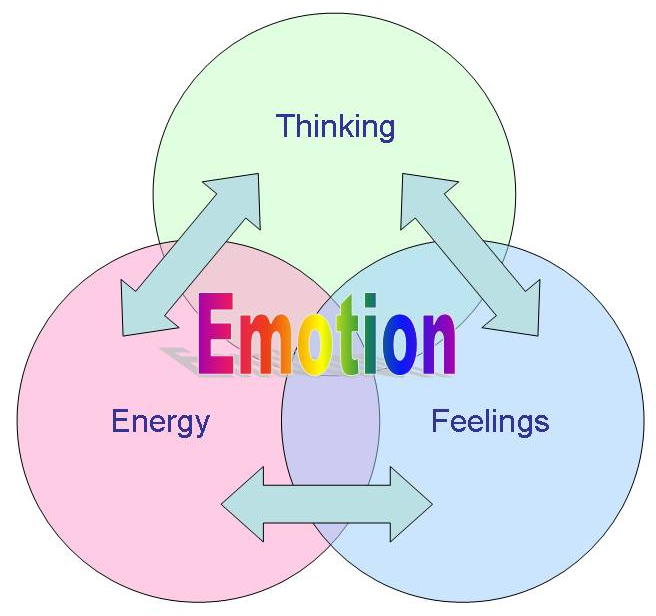
As a stress adviser I found this diagram to be useful showing emotions to have three components:

emotional health

Emotion

The arrows are there to show how:

  • The way we feel can affect our energy and our thinking.
  • Our energy can affect the way we feel and the way we think.
  • Thoughts can affect our energy levels and our feelings.

I was told I had a mental illness. ‘Mental’ being to do with thinking, it made sense to me that if I could improve my thinking that would sort out my problems. In fact, improving the way I was thinking did help me to recover.  I wrote about this my first book, Stop Paddling/Start Sailing. Readers have told me how much it has helped them.

The reality is, thinking alone does not provide lasting recovery or build resilience. If your feelings and energy levels are kind of out of control then simply reading Stop Paddling/Start Sailing is unlikely to do much towards a full and long lasting recovery.

Eventually, I was amazed and delighted to discovered I was not mentally ill. I was not even ill. I had a mood problem and for this  I needed to understand that FEELINGS and ENERGY are the components mood. Knowing more about how to feel differently and have more control of energy levels turns out to be an excellent place to start recovering from being labelled with bipolar disorder.

Next time… Looking at Feelings and Energy to provide a balanced approach to having moods that are good for you and those you live with.

Bipolar Recovery Bite-size – Mood Mapping #moodmapping

Two years ago I was writing ‘Bipolar Recovery Bite-size’.  This was to explain how I and others had come to understand what had happened to us and so recovered from the diagnosis. The reason for ‘bite-size’ was that emotional disturbances can make it difficult to read long articles – The challenge became one of sharing this important information in small chunks/bites.

I have started updating all the bipolar recovery bites and over the next few weeks hope to share the new versions here at Rethinking Bipolar

1.What are emotions made of?

Fourteen years ago as a patient on an acute psychiatric ward I was told I had an emotional disorder that would need to be treated with medication for the rest of my life. I was given a label, “Manic depressive”. There was no explanation of emotions, what was causing the disorder or what I could do other than take tablets.

I wonder how different the next few years of my life would have been if the psychiatrist had been able to explain to me something about emotions.

Perhaps he thought I was too ill to understand or perhaps he did not know how to explain?

We all have an idea what emotions are and yet we all seem to explain emotions in different ways. Emotions mean different things to different people.

 Before reading bite 2 , “Emotions Are Made Of…”, how would you describe emotion? 

Childhood bipolar – Is it the strangest, most controversial diagnosis? #childhoodbipolar

When we wrote our handbook we researched ‘childhood bipolar’ and felt it was a bit of a crazy/controversial diagnosis. Diagnosing anyone under the age of about 21 with a mood disorder seems bizarre. Having variable moods is part of being a child. Having variable moods (in perhaps a slightly different way) is for most people part of their teenage years.

Creating the childhood-bipolar-diagnosis was controversial at the time with funding for the creation and promotion of this new diagnosis being provided by a drug company.  Check out Robert Whitaker’s book that explains who was involved with creating this diagnosis.

Childhood bipolar is diagnosis 6 in this top ten. The others are perhaps equally wacky and shocking. If it were not for the serious detrimental outcomes for those diagnosed…

Have a read for yourself – be sure to click on the number 6 (the next button did not work for me).

http://www.livescience.com/12908-top-10-controversial-psychiatric-disorders.html

Some benefits to having extremes of mood #bipolar #bipolarhope

Thoughts on work at  Lancaster’s (Bipolar) Spectrum Centre, UK

Bipolar ‘disorder’ has to be one of the most fascinating disorders ever described. It is difficult to think of any other disorder where such a high proportion of those diagnosed are so keen to keep the label. This perhaps is less surprising when we consider that to stop being seen as bipolar we may need to:

  • be a lot less energetic,
  • work less,
  • sleep more,
  • be less creative
  • and most likely put on extra weight

– none of these things especially appeal to me.

When active we can all tend to over-estimate just how productive and creative we can be. To understand the true picture some rigorous level-headed research is needed. Yesterday the spectrum centre shared news of such a study. Here is an extract:

“It is really important that we learn more about the positives of bipolar as focusing only on negative aspects paints a very biased picture that perpetuates the view of bipolar as a wholly negative experience. If we fail to explore the positives of bipolar we also fail to understand the ambivalence of some people towards treatment.”

It is just 730 words so well worth a read… http://www.sciencedaily.com/releases/2012/05/120503115927.htm

When a diagnosis is not diagnostic #bipolarlabel #bipolarlabel

Full recovery means different things to different people. It used to be about returning to the sorts of things you used to do before diagnosis.

I was thinking of full recovery as having an expert say that you never had the disorder and having the damaging diagnosis removed. Well, I have met with experts who agree that I was suffering from extreme anxiety and not bipolar. Unfortunately there is still no system in the UK for removing psychiatric labels.

Here, Dennis Dodson of  Tennessee. explains how he has achieved recovery, not through psychiatry, but by starting with the dictionary! He explains that we were not really diagnosed at all, as diagnosis involves, “investigation or analysis of the cause or nature of a condition, situation, or problem”, and “the art or act of identifying a disease from its signs and symptoms”.

I agree. No psychiatrist ever made an effort to find out what was wrong with me or what caused my troubles. So that means I was simply labelled and not diagnosed.

Read what happened to Dennis…

http://gaia-health.com/gaia-blog/2012-04-21/diagnosis-from-a-psychiatric-patients-point-of-view/?goback=%2Egde_164693_member_109530795